


Table of Contents[Hide][Show]
- How Blood Sugar Is Measured in Canada
- Normal Blood Sugar Levels Canada
- Blood Sugar Levels Chart Canada vs USA
- Fasting Blood Sugar Levels Canada
- Normal Blood Sugar Levels Canada (Non Diabetics)
- A1c Levels Canada
- What Is Considered Prediabetes in Canada?
- Prediabetes A1c Canada
- What Is Considered Type 2 Diabetes in Canada?
- A1c Target Diabetes Canada
Looking for an actual normal blood sugar levels chart for Canada? They can be hard to come by, as lots of sites don’t actually state what the numbers are!
Understanding your numbers is one of the most important factors when you’re living with type 2 diabetes or prediabetes, or if you want to know what your diagnosis means.
We’ll clear it up for you with a detailed chart for Canada and an explanation of normal blood sugar, fasting blood sugar and what’s considered prediabetes and type 2 diabetes in Canada.
How Blood Sugar Is Measured in Canada
In Canada, blood sugar is measured in millimoles per liter (mmol/L).
There are several blood tests your doctor may use:
- Fasting plasma glucose (FPG) also known as fasting blood glucose (FBG): Taken after not eating for at least 8 hours.
- Oral glucose tolerance test (OGTT): Measures blood sugar before and two hours after drinking a sugary solution.
- Random plasma glucose: Checked at any time of day, with or without eating.
- Hemoglobin A1c (HbA1c): Reflects your average blood sugar over the past few months.
All of these blood tests are taken by the pathology centre. Each test tells part of the story. Together, they help identify whether your blood sugar is normal, in the prediabetes range, or in the diabetes range.
Normal Blood Sugar Levels Canada
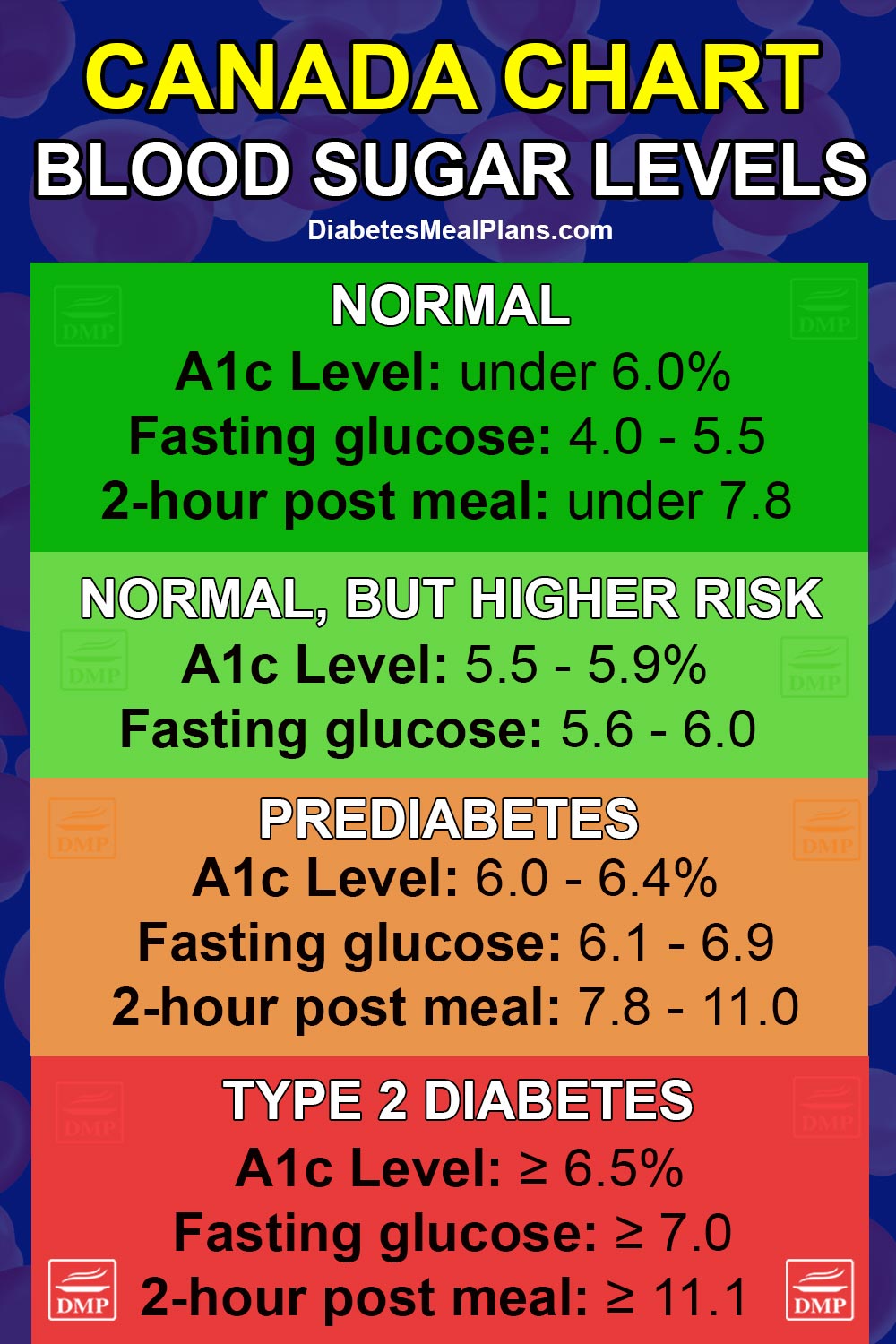
Here is the chart based on Diabetes Canada’s Clinical Practice Guidelines:
| Test | Normal | Prediabetes | Diabetes |
|---|---|---|---|
| Fasting Plasma Glucose | 4.0–5.5 mmol/L | 6.1–6.9 mmol/L | ≥7.0 mmol/L |
| 2-Hour OGTT (75 g load) | <7.8 mmol/L | 7.8–11.0 mmol/L | ≥11.1 mmol/L |
| Random Plasma Glucose | — | — | ≥11.1 mmol/L (with symptoms) |
| Hemoglobin A1c | <6.0% | 6.0–6.4% | ≥6.5% |




Blood Sugar Levels Chart Canada vs USA
You may notice different numbers depending on where you look up “normal” or “prediabetes” blood sugar levels. That’s because lots of resources online come from the US, which use slightly different cut-offs to Canada.
In Canada, prediabetes is diagnosed at:
- Fasting glucose: 6.1–6.9 mmol/L
- Hemoglobin A1c: 6.0–6.4%
- 2-hour OGTT: 7.8–11.0 mmol/L
In contrast, the American Diabetes Association defines prediabetes at lower thresholds:
- Fasting plasma glucose: 5.6–6.9 mmol/L
- Hemoglobin A1c: 5.7–6.4%
- 2-hour OGTT: 7.8–11.0 mmol/L (same as Canada)
This distinction is important when you’re reading online resources, since many articles, use American Diabetes Association definitions.
If you live in Canada, make sure you’re looking at Canadian guidelines, or sites like ours that cater to Canadians and people all over the world, so you can interpret your results correctly.
Fasting Blood Sugar Levels Canada
Your fasting blood sugar is the level of glucose in your blood after not eating or drinking anything (except water) for at least 8 hours. This test is usually done first thing in the morning and is one of the simplest ways to check your glucose control.
According to Diabetes Canada:
- Normal: 4.0–5.5 mmol/L
- Potentially at higher risk of prediabetes or type 2 diabetes: 5.6-6.0 mmol/L
- Prediabetes (impaired fasting glucose): 6.1–6.9 mmol/L
- Diabetes: 7.0 mmol/L or higher (confirmed on repeat testing if you don’t have symptoms)
Even though 5.6–6.0 mmol/L is not officially classified as prediabetes in Canada, it may still signal that your blood sugar control is slipping.
At this stage, you’re at higher risk of progressing to prediabetes or type 2 diabetes, so it’s a valuable early warning sign to take action with nutrition and lifestyle changes. And it is worth screening blood sugar levels on a more regular basis.

Normal Blood Sugar Levels Canada (Non Diabetics)
For adults without diabetes, blood sugar stays within a fairly narrow range. In Canada, the normal values are:
- Fasting glucose: 4.0–5.5 mmol/L
- Fasting glucose (still normal but you may be at higher risk): 5.6-5.9 mmol/L
- 2-hour OGTT: less than 7.8 mmol/L
- A1c: below 6.0%
- A1c (still normal but you may be at higher risk): 5.5 to 5.9%
If your results are in these ranges, it means your body is producing insulin efficiently and your cells are responding to it properly, and you don’t have prediabetes or type 2 diabetes!
Make sure you stay proactive to keep it that way!
A1c Levels Canada
The A1c test (also called hemoglobin A1c) shows your average blood sugar over the past 2 to 3 months. It does this by measuring the percentage of sugar attached to your red blood cells.
Because it reflects long-term glucose control, A1c is one of the most common tests used to diagnose and monitor diabetes.
According to Diabetes Canada:
- Normal: below 6.0%
- Prediabetes: 6.0% – 6.4%
- Diabetes: 6.5% or higher
What Is Considered Prediabetes in Canada?
In Canada, prediabetes is diagnosed when your blood glucose levels are higher than normal but not yet high enough for type 2 diabetes.
You will be diagnosed with prediabetes with the following test results:
- Fasting plasma glucose (FPG): 6.1–6.9 mmol/L
- A1c: 6.0%–6.4%
- 2-hour OGTT (after 75 g glucose drink): 7.8–11.0 mmol/L
Often your medical doctor will perform two different tests to confirm your diagnosis, unless you present with clear symptoms of prediabetes such as fatigue, frequent urination and thirst.
If your results fall in any of these prediabetic ranges, it means your body is starting to develop insulin resistance and struggling to keep blood sugar in the healthy range.
This stage is a critical window of opportunity for you. By making nutrition and lifestyle changes, many people are able to lower their numbers back to normal and prevent progression to type 2 diabetes.
Prediabetes A1c Canada
To clarify, prediabetes A1c in Canada is 6.0%–6.4%, not 5.7%-6.4% in the US.
But, if your A1c level is 5.5%-5.9% the guidelines suggest you are ‘at risk’ and should have blood sugar screening more often.
In real terms, if your A1c levels come back at 5.5%-5.9%, this is an early early warning sign for you to get proactive and improve your diet, exercise more, stress less, and get good quality sleep.
All of those factors will improve your blood sugar control and prevent you getting prediabetes!
What Is Considered Type 2 Diabetes in Canada?
In Canada, type 2 diabetes is diagnosed when blood sugar levels are consistently above the normal and prediabetes ranges. Thankfully, all places around the world are the same when it comes to a type 2 diabetes diagnosis.
Diabetes Canada sets the following cut-offs:
- Fasting glucose (FPG): 7.0 mmol/L or higher, confirmed on repeat testing if no symptoms are present
- A1c: 6.5% or higher, confirmed on repeat testing if no symptoms are present
- 2-hour OGTT (after 75 g glucose drink): 11.1 mmol/L or higher
- Random plasma glucose: 11.1 mmol/L or higher if accompanied by classic symptoms (such as increased thirst, urination, or unexplained weight loss)
If your results fall in these ranges, it means your body is no longer able to regulate blood sugar effectively due to worsening insulin resistance (most common) and declining insulin production (much less common).
The diagnosis can feel overwhelming, but it’s important to remember that type 2 diabetes is treatable and manageable, and with the right nutrition and lifestyle steps many people see their blood sugar return to normal and even put their diabetes in remission, reversing their diabetes – so please don’t panic!

A1c Target Diabetes Canada
Once your blood sugar levels move outside the normal range, it’s important to know what target you should be aiming for. The A1c test is one of the best tools for tracking long-term glucose control, and Diabetes Canada provides clear guidance on targets.
For most adults living with type 2 diabetes, Diabetes Canada recommends an A1c target of ≤7.0%. Reaching this level has been shown to reduce the risk of complications such as eye, kidney and nerve damage.
However, research shows that the closer you can get to the normal range (below 6.0%), the better your long-term health outcomes are likely to be. So, aiming for normal A1c levels or as close to normal as you can possibly get, is the best target.
The key takeaway is this: while 7.0% is the general target, normal is always the ideal. Each step you take that lowers your A1c, even by 0.5%, reduces your risk of complications and supports better energy, weight and overall health.
Hope you’ve found this Canada blood sugar levels chart and explanation helpful. If you have a question yourself, please leave it below and one of our professionals will answer it.

Leave a Reply