


There is so much more to Charles’s story than an A1c result.
He learned. He took action. He focused on small, achievable changes. And over time, he developed knowledge, skills and habits that can support his health for the long term.
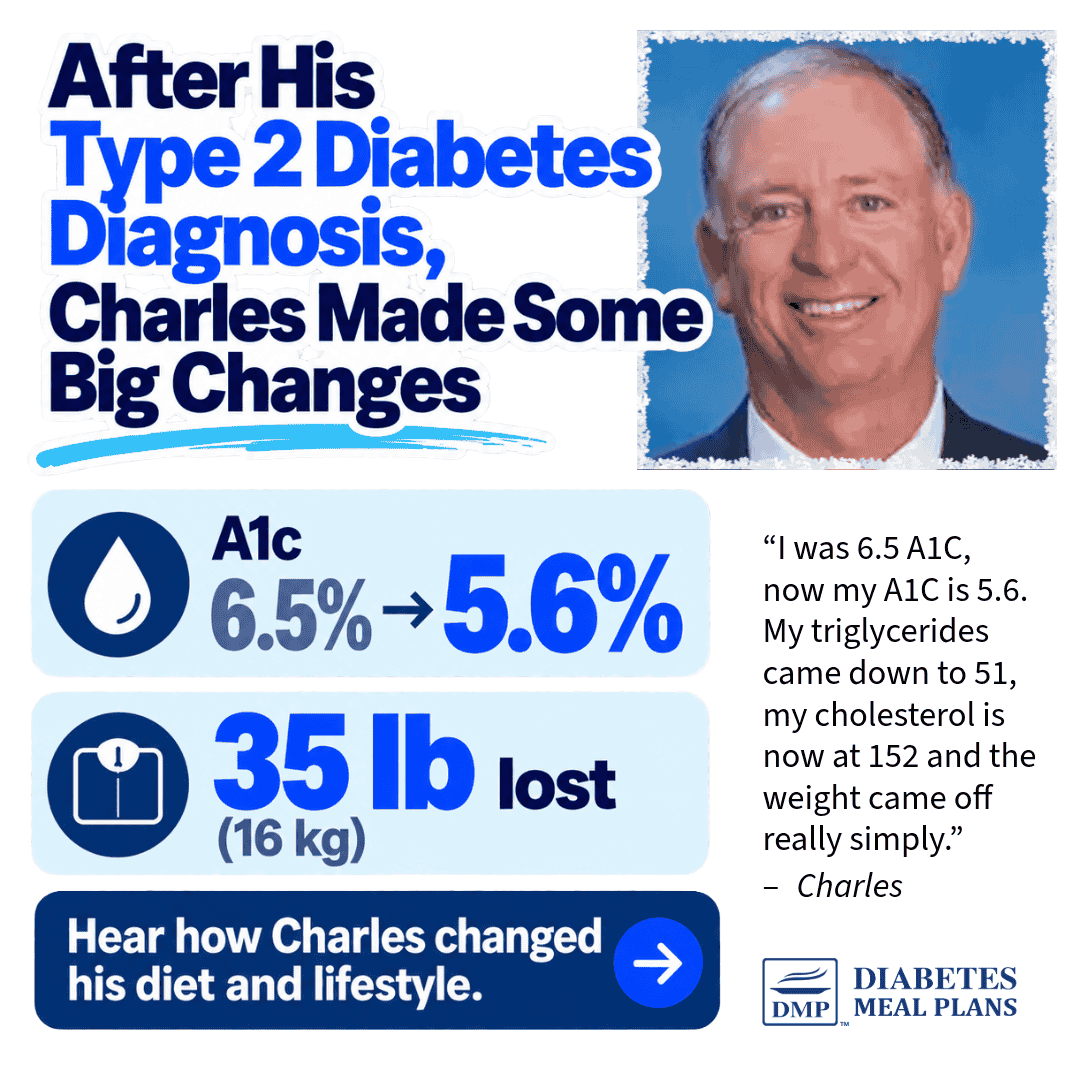
In episode 132 of Type 2 Diabetes Talk, you’ll hear Charles share his journey in his own words — from receiving his diagnosis to changing the way he eats, losing 35 pounds (16kg) and bringing his A1c down to 5.6%to achieve type 2 diabetes remission.
PODCAST VIDEO
PODCAST AUDIO
Support the podcast by leaving a 5-star rating and review on Apple, Spotify or our Website – Thank You!
Charle’s Type 2 Diabetes Story
When Charles was diagnosed with type 2 diabetes, it came as a shock.
His A1c had reached 6.5%, he weighed 230 pounds (104 kg), and having watched his father experience serious complications from diabetes, Charles knew he wanted to take action.
But like many people after a new diagnosis, he was also faced with a lot of unfamiliar information.
What did all those blood test numbers mean? What should he eat? What actually needed to change?
That’s when Charles discovered the Type 2 Diabetes Talk podcast and DMP.
Results: From A1c 6.5% to 5.6%
When Dr Jedha recently sat down with Charles to talk about his journey, his results were fantastic.
His A1c had fallen from 6.5% to 5.6%, while his weight had dropped from 230 pounds to 195 pounds — a loss of 35 pounds (16 kg).
He also reported improvements in other areas of his health, including triglycerides of 51 mg/dL and total cholesterol of 152 mg/dL.
But what stood out the most wasn’t simply the numbers. It was what Charles had learned along the way.
Newly Diagnosed Type 2 Diabetes: Learning What to Do
Charles spoke several times about the importance of education.
Instead of simply being told that his numbers needed to improve, he began learning what those numbers actually meant. He learned more about carbohydrates and food, and began to understand how his everyday food choices could influence his health.
As he put that knowledge into practice, those changes gradually became part of his lifestyle.
And that’s an important distinction.
Improving your health isn’t simply about following a diet for a few weeks. Building knowledge and practical skills can help you make informed choices again and again — at home, at the supermarket, while traveling or when eating at a restaurant — that’s exactly what we help our members do, easily.
Consistency Over Perfection
Charles is a college tennis coach, so perhaps it isn’t surprising that one of his biggest lessons was the value of consistency.
His advice was to set small, achievable goals and keep working at them.
That’s something we emphasize here at DMP too: consistency over perfection.
You don’t have to completely transform your life overnight. Small steps, repeated consistently, add up to significant changes over time.




Ongoing Support Matters A Lot
Another important point Charles raised was the value of having ongoing education and support.
Healthcare appointments are important, but you’re living with diabetes every day.
Questions arise. Motivation changes. New situations come up. And knowing what to do is only the beginning. Putting things into practice and maintaining those changes is where the real work happens.
Interestingly, ongoing support is something participants have also highlighted as valuable in our published research into people’s experiences of participating in the T2Diet program.
Charles has his own way of describing the DMP community and support: having a “posse.” It’s always valuable to have a community you feel a part of, sharing goals that others similarly share.
When you join us as a member, you get monthly member check ins with our diabetes nutrition experts and lots of ongoing support to stay on track and achieve your goals.
We hope you consider joining us today, so we can support you too.
Transcript
Click Here To View
Charles: 00:00
I was 6.5 A1C, but now my A1C is 5.6 and was 230 pounds. I just dropped my weight. I was the 195. I’m a testimonial for what you do. So thank you.
Intro-Outro: 00:15
Welcome to Type 2 Diabetes Talk.
Dr Jedha: 00:19
When Charles received his type 2 diabetes diagnosis, it came as a shock, as it does for many people. He was left feeling intimidated by the results and overwhelmed by all the numbers and what they meant. When he reflected on his father’s journey with diabetes and the serious complications he ended up having, that really motivated him to take some action and make some changes. We’re going to sit down with Charles and hear about what he learned, what he changed, and his life right now transformed with type 2 diabetes in remission. Before we get into the podcast, I just want to say a big thank you to Charles and all the other members that I’ve recently met with, which has just been such a pleasure, and you’ll all be hearing from more of their stories in the very near future. I just love it when members step up from taking our program and share their results, share their stories, share what they’ve changed and everything else, because it really is truly inspiring for me, and I hope it’s inspiring for you too. The important thing is no matter where you are now, you can make changes. So take this story as inspiration and use it to take that next positive step forward. For now, let’s sit down and have a chat with Charles.
Dr Jedha: 01:47
Thank you so much for meeting with me today. I’m so excited to share your story.
Charles: 01:53
Well, I appreciate you and uh um you really have done a lot for a lot of people, and you did a lot for me. So um the thanks is to you and Well, let’s let’s get into it.
Dr Jedha: 02:05
Like when you first came to DMP, you were newly diagnosed type 2 diabetes, right? So I guess that’s a great place to start to kind of reflect back to what was going on for you then and and how you came across DMP and my work and everything.
Charles: 02:24
Um, well, I’m I’m a college tennis coach and I’ve been coaching for 38 years. You kind of neglect a little bit, I think, your body, uh, a little bit, you know, you’re putting everybody first, and and uh that’s what I was pretty much doing. And um, I’m preaching to be disciplined to my guys on the team, and so um, and I have a really good uh physician, and I have these yearly or half every half year I’d get a checkup, and the numbers just kind of kept getting hey, not so good, we gotta get better. So December 2nd of 2024, um well, I hit that number that I was type two, and uh my dad was type two, and I remember that, and uh uh he lost a leg, and I was like, all right, this is a mo I’m gonna crush this, but how am I gonna crush this? I found you, um, you know, it was a podcast that you had, and it was so helpful because like when you get that diagnosis, there’s a lot going through your head, as you say in your podcast. And uh I just dove in with that and just said, okay, you know, take a deep breath. How are we gonna how are we gonna approach this? Um, you know, your your information was so helpful just to know what these numbers really meant um to me and how I was gonna change these numbers. I just actually heard your last podcast, you talked about it’s not the end of the story, it’s a new chapter. And and that’s how I approached it and just really attacked the your plan and uh you know went through uh joined your your program and went through the the menus and and the list of what you could eat and what that means and how do you want to uh how how can I do this? And really that’s that was it. And and I the numbers kept motivating me. I after six months they went down, and after a year keep going down, they were you know, everything was going really well. My last checkup was really good, and uh yeah, I just I really owe it all to your program and and um I enjoyed going to the doctor because I was ready for to, you know, have a have a better a better some better numbers and like a little bit better beating, I guess, with my doctor.
Dr Jedha: 04:50
Yep. Yeah, and that I think that was one thing that really stood out to me when you came in, when you you really just did embrace it as that opportunity, as that new chapter, like you were really positive, like you came in with that positive attitude. Okay, I found something I think can help, and I’m just gonna go in all in, right?
Charles: 05:15
I’ve been, I guess, uh kind of a goal person anyway. So I’m like, all right, let’s make let’s try to set some goals. I’m a real positive person. I think obviously I think that’s why I really liked your podcast, because I just think you come at it as being positive, something what can you do? Uh, and versus I guess things that you can’t do. And and then you also celebrate all the victories that people have that you have worked with. And I think that’s you know, kind of a that’s a coach, you know. Coaches do that, and they they try to motivate their people and they try to get them to to to learn on their own. We give them the tools needed that um that’s what you did, um, and that’s what your program does. So I just just kind of bought into it as you’re my coach, I would take long walks, listen to your podcast, you know, pick stuff up that I needed, and just kind of try to to do that. Um yeah, uh I’m a testimonial for for your for what you do. So so thank you.
Dr Jedha: 06:14
That’s great, Charles. And can you share what your results were, like where your starting point was and what they are now?
Charles: 06:21
I was 230 pounds. I’m 6’1, but that was a little too heavy for a tennis player. I was 6.5 uh A1C, but my glucose was right around 100. And but also I had some cholesterol things too. So like when I started my diet, my change, those went way down. As you had mentioned in my last like email with you, you like triglycerides came down to 51, my cholesterol is now at 152, and now my A1C is 5.6, and yeah, glucose is still 97. Uh, but you know, you you actually taught me the difference between the two, which you know, as you talked with the A1C about the three months of the average, and I just and that really helped me a lot so I could really know what that number meant, and really understood that my lifestyle changes was really affecting this. And obviously, I just dropped my weight. I was the 195, and actually, that weight dropped off. I just focused, I think you had talked, just focus on your diet right now, and then we’ll get to it. And then I added the workouts and all that stuff, but uh the the way came off with it really simply with the diet, and I really just went, let’s just focus in on eating what you you know, what you can eat, and let’s see how it goes. And it it really worked. Like, I’m just like I was so impressed by that.
Dr Jedha: 07:41
Yeah, that’s fantastic from 6.5 down to 5.6. So you basically back it down into the normal range now. 35 pound weight loss and cholesterol and triglycerides that look amazing. So they’re I mean, what great health improvements. You just must feel a lot better.
Charles: 08:00
I feel great. I really do. I actually had a little bit of sleep apnea at the time when I was 230, and that went away. I mean, I guess I could go on and on, but yeah, sleeping better and feeling better, you know.
Dr Jedha: 08:12
It’s no, that’s a they’re really great.
Dr Jedha: 08:15
I’m just so pleased that you have been proactive and being newly diagnosed too is such an opportunity to start that new chapter if you take, you know, those reins and how much of a difference that can make in such a short time. And now your whole future, I guess, looks completely different than perhaps what it could look if you didn’t take action.
Charles: 08:39
Yes. I mean, I’ve a little grandbaby that is uh about seven months old, and you know, I want to be around. It’s a bit exciting to get up every day and just to learn something about you know this. And really, like your recipes and your or your menus and your list of foods, like I really said, all right, what what do I love on there and what you know and I’ll eat that stuff. Also, the your all of your talks on the carbs and like what that means and the good carbs and the bad and all that stuff, that stuff really helped me to um, you know, understand the food. And it really hasn’t been that hard hanging around college kids. They can eat anything, but I’ve learned wherever we go when we were out to eat on trips and stuff, is I can really almost anywhere I can go, I can go low carb. I you know, there’s no real excuse for me not to. And my family’s kind of jumped in with me. I mean, they’re they’re maybe not the exact diet, but they’ll they’ll eat with me that way, and they’re good with that, and they think of me when I’m when they’re cooking, so yeah, I’m I’m real fortunate there, but it’s really been our complete lifestyle change.
Dr Jedha: 09:46
Yeah, because uh obviously the the numbers have been motivating, but what you’re saying is that you’ve just really built a lot of knowledge and skills through learning as well, and and taking that on board and putting it into action, and that’s what’s changed a lot of different things, not just your blood glucose too, but even just your lifestyle.
Charles: 10:06
Yeah, yeah. I mean, I just think uh I think you know, you’re just until you have to worry about it, I guess you don’t really pay attention to all the things that you’re paying attention to, and then now all of a sudden when you have to, um, that knowledge is just real powerful to me to know um what’s going on in my body when I eat something, you know, you are what you eat, and you start to realize like this is true. And you know, when the younger kids I deal with, you know, they burn off a lot of that stuff that at 61 you’re just not, and you gotta come to grips with that stuff, you know.
Dr Jedha: 10:43
Yeah, that’s true, exactly. And we our bodies do change, our metabolism does change a bit as we get older. So we do need to make it some adjustments, unfortunately or fortunately, perhaps.
Charles: 10:53
Yeah, probably fortunately. It’s all good. I think no matter what, you know, you’re you you’ll have help from your physicians and stuff, but I think really you gotta do a lot on your own. I think that’s the thing. Just can’t expect somebody to do it for you or to get a shot and you’re gonna be good or something. I think that’s the thing that your program is. It’s constant support, not just uh, you know, one one appointment and someone says, Hey, you gotta do a lot better. Um, you know, you got you got some I think you got a posse when you when with when you have the DMP in all there, and that’s really nice.
Dr Jedha: 11:28
Yeah, no, that’s that’s great to hear, and it is so true as well, because it’s so difficult. If you just have one appointment, doesn’t matter who it’s with, a dietitian, a diabetes educator, your medical doctor. There’s only so much in that whatever, 10 minutes, half an hour, one hour. It’s an ongoing, you need that ongoing input, that ongoing support to be able to make those changes too.
Charles: 11:54
Absolutely. I mean, I think it’s like you said, it’s only can so much can be done in a half hour, 45 minutes if you’re lucky. And you know, you need that. You need uh the program, I feel like is the biggest thing is you just you know, you’ve got podcasts, you’ve got things that are coming across your desk that you’re letting people know what what numbers mean. And I think that um because when you go to a doctor, you just you know you get all these numbers and you get a little bit intimidated, that you’re what they are, right? Yeah, then I think you are explaining things, um and telling people what they what this means and then how you handle it. And okay, this is how we’re gonna do this. This is this is the play, and I think that’s super it’s super needed because otherwise I really would think that if I didn’t have your program, it just would have been way tougher for me to to really figure it all out.
Dr Jedha: 12:54
I always like to ask people, and I think you’ve probably given a lot of advice already by what you’ve said, just n other people who are newly diagnosed listening to this will just be like, Oh yeah, that’s just so many insightful things there already. But always like to ask the question, what would be your best advice to someone else who might be thinking about making a change?
Charles: 13:16
I think keep the goals like real simple, real attainable, and then consistently hit those goals. Like just say, All right, I’m gonna keep doing this. Give me six months, I’m gonna do this every time. No cheating, just do everything I can. And when you see that, then I don’t even know if it’s you’re really you start to build these habits, and then it becomes just not even you know. I I think that attainable goals, that’s the way to do it, set up small little goals and just try to just stay with that just something that you know you can hammer out every day and not go, okay, I want to run a marathon, you know, and then you reject, you know, really feel bad that you can’t do something like that. So I guess those small little goals will really and then you’ll see those changes, and once you see those changes, I feel like you’re realize what why you’re doing it, what you’re doing, and how it affects you. And then I think you’re off from there.
Dr Jedha: 14:15
That’s great advice, and it’s so true because we don’t get to a goal by doing one thing one day, like changing one meal on one day. And as you would know as a coach, you know, coaching sport or whatever it is, it’s those consistent things you do every day over time that really make a they do add up.
Charles: 14:35
Yeah, it’s just their fundamentals. You’re right. I mean it’s exactly everything. I guess that’s why I realize if I could be consistent with it, it would give you a chance to run your program through me, and I could, you know, if I do it exactly the way, then I, you know, the results will come. And then that’s I think that’s otherwise you’re just bouncing back and forth and and you’ll never see if it really works. And I think, you know, the check-ins that you have, those are I really like those. I don’t go to every do every check-in, but usually I like to report some numbers if it’s a weight loss or something I want to do better, or after my six-month checkups, I like to put the numbers in and just do that. I think that’s I I don’t know if you call it holding people accountable or something, but just hey, minor victories and celebrations and and uh you know your program. Uh yeah, I feel like I’m with a group of people, they’re all trying really hard to navigate this, and you’re helping. And I think all that, all your resources that you provide are just super helpful. And as you said in the beginning, you can’t consume it all at once, but you can you can you can take a long drive and you put your podcast on, or or you know, when you have time, I I I love it and I always learn something. So you’re doing great.
Dr Jedha: 15:58
Uh thanks, Charles. I really appreciate it. It’s been such a wonderful opportunity to be able to support you as well to better health. I that’s what inspires me every day is is the community of members and and what everybody’s doing and the fact that it’s helping because that’s why I do what I do.
Charles: 16:17
Yeah. Well you’re doing doing a great job, and I’m glad I found you. And um just please keep doing it. I think there’s just I mean, I’m sure you just can’t believe all the people that you’re you’re connecting with around the world and changing their lives. And I I would say that with all the people that are joining, and and it’s just trying to have those nice small goals and and and you’re really helpful with that. I mean, you’re really with the numbers um and people trying to just you know do as much as they can with in their in their with what they’re dealing with, but I I think that’s the way to do it.
Dr Jedha: 16:56
Well, thank you so much. It’s been a pleasure to meet with you today.
Charles: 17:00
Well, Dr. Joe is I thank you for reaching out to me, and I’m super supportive of your program. And if there’s ever anything that I could do, um uh just let me know. All of your the your programs and um your question and answers with people and everything. I I love those things because then you real people were making real change, so you I think that uh that really helps helps everybody.
Dr Jedha: 17:28
Wow, what an incredible story, right? And there’s three important things I want you to take away from Charles’s story today. The first one is the power of education. We heard from Charles several times that education was important because he went and got his diagnosis, he got thrown all these numbers, and you might be given your A1C, your fasting glucose, your cholesterol, and maybe some medications. What do you do with all those numbers? It is intimidating and overwhelming. You need to know how to take all that information and turn it into something, and that’s where education’s powerful. Charles explained that once he started listening to the podcast and once he became a member and had access to more resources and support, he was able to understand what those numbers meant, understand what foods and carbohydrates and everything, his lifestyle, how that all affected his blood sugar numbers. So he could take all of that and turn it into practical strategies that he could apply in everyday life. And that’s something I’ve always believed very strongly. When you understand what’s happening in your body and you have practical strategies you can use, you’re in a much better position to actually improve your health. The second thing is something Charles knows himself from being a coach, and that is results come from consistently doing small things. And one of the mottos that I have is consistency over perfection. You do not need to change everything all at once. And when people are newly diagnosed, that’s something that the overwhelm can make you feel. Like you have to just race out and do everything all at once. And then all of a sudden, people stop doing anything because it all seems too hard. So you don’t need to do that. As Charles shared, make small, achievable goals and take those small steps every single day. And look what Charles achieved. His A1C went from 6.5 down to 5.6. He lost 35 pounds or 16 kilos, and he improved his health overall as well. Instead of rushing out to try and change everything, focus on the next best step, then the next, then the next, and keep taking those small positive steps forward because they really do add up. But the important thing is that you know what steps to take. And one of the key mistakes I see people making is taking the wrong steps at the wrong time or trying to change too many things at once. And that’s what we help our members stay focused on when they use their monthly member check-ins. And the third thing is that ongoing support really matters. And Charles pointed this out really well by saying that we can go to the doctor and might get a 10 or 15-minute appointment, or maybe it’s a specialist, a dietitian, or a diabetes educator, you might get a bit longer. But you’re living with diabetes every single day. So that ongoing support is really helpful. And that’s something that we discovered in the T2 diet clinical research as well. So after people had finished the clinical trial, we spoke to a number of participants about their experience in the program. They said that having continued guidance, reliable access to information they could trust, and that ongoing reinforcement was one of the most valuable parts of the program. One participant said, and let me read this by quote, there was no pressure. It was just there when I needed it. And you know, I’d go back and look at things and re-listen and reread things. Another participant said, if you didn’t have a weekly touch point, you could easily drift away. But it was just that constant reminder. And after, probably after four or five weeks, we were well, you know, on board and just looking for the next week’s advice and we’d go from there. Now I’m reading from the published paper there that there are a whole range of participant responses. And that’s the thing. Knowing what to do is one thing, but actually putting it into practice, working through the challenges, understanding your numbers as you go, and implementing those changes over time, that’s where the real work happens. And I love the way Charles explained this because he said that when you’re part of DMP, you’ve got a posse. That’s what he said. And really, that’s exactly what we want people to feel is that they’re part of a community, part of people having a similar experience, all there to support one another, all there to be them best selves and improve their health. And that’s what our community does. And it’s such a wonderful thing to see that everybody shares that experience together. So if I could sum up Charles’s story, I’d say learn what you can, set small achievable goals, be consistent rather than perfect, and get support along the way. Without a doubt, Charles’s results are fantastic. He’s achieved type 2 diabetes remission and he intends to keep it that way.
Charles: 22:56
I do consider it just remission. I never consider myself, okay, I’m back to normal. I can do whatever I want. I’m not ever going to be that guy. So I think that I I need to stay that guy and uh and say, hey, this is something I gotta deal with for the rest of my life. But you know, it’s, you know, I’m I’m enjoying my meals, I’m enjoying what I’m eating.
Dr Jedha: 23:20
But more importantly, Charles has developed the knowledge, the skills, and the habits that are going to help him to sustain these results over the long term. And that’s what I hope that all people achieve through my work. So again, a big thank you to Charles for sharing his inspirational story. It really is so important to get these stories from real people who are achieving these real results through our program out to everybody else so you know yourself what’s possible. And remember, no matter where you are right now, please just take one step forward and keep on going. That’s all from me right now, Dr. Jeddah over and out.
Intro-Outro: 24:08
Thanks for tuning in to Type 2 Diabetes Talk. For episode replays, episode notes, and more. Visit type2diabetestalk.com.

Subscribe to Type 2 Diabetes Talk on: Apple | Spotify | Amazon Music | Audible | YouTube | Podcast Index | Player FM | and more…
Leave a Reply