


If you’ve been told to watch your carbs, rice might be one of the first foods you’ve questioned. And for good reason, rice can send blood sugar soaring!
But you may have heard that basmati rice is good for diabetics compared to other options.
Let’s explore whether basmati rice really has a place on your plate and how it affects blood sugar levels, in type 2 diabetes or prediabetes.

What Is Basmati Rice?
Basmati rice is a long-grain variety traditionally grown in the Indian subcontinent. It has a distinct aroma and fluffy texture that sets it apart from other types of rice.
You’ll find both white and wholegrain (brown) versions of basmati, and in some cases, pigmented types like red basmati, which retain more of the bran layer.
What makes basmati rice different from other white rices is its higher amylose content and firmer structure, which influence how it breaks down in the body, slowing its digestion and lowering its potential impact on blood sugar levels.
Basmati Rice Nutrition Facts
Take a look at the nutritional profile of cooked basmati rice (white), per 3.5 oz/ 100 grams (approximately half a cup):
- Calories: ~134 kcal
- Carbohydrates: ~29 g
- Protein: 3.5 g
- Fat: 0.2 g
- Fiber: ~1.3 g (white) | ~1.5–2 g (brown/red)
Wholegrain varieties such as brown or red basmati offer more fiber, magnesium, and phenolic compounds compared to the white version, which has had the outer layers removed during polishing.
Comparison to Other Types of Rice
Not all rice is created equal when it comes to blood sugar impact. Here’s a comparison of other types of rice.
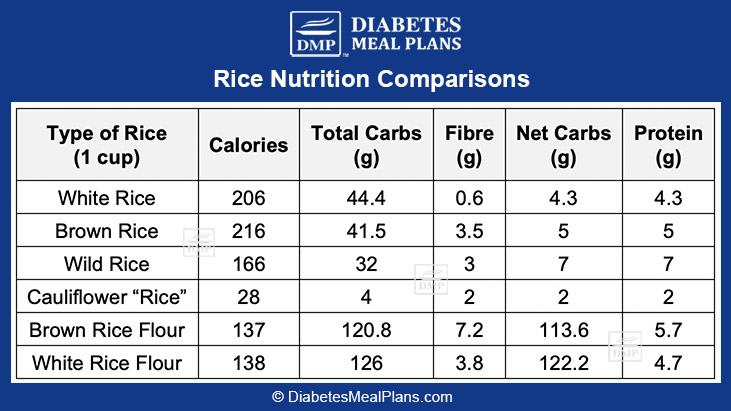
Basmati stands out in a few important ways:
- Glycemic Index (GI): White basmati rice has a moderate GI, typically around 57–66. Brown and red basmati may be lower. This is significantly better than jasmine rice (GI ~ 80–90) and most short-grain white rice varieties (GI ~ 70+).
- Amylose Content: Basmati rice is higher in amylose, a type of starch that digests more slowly, resulting in a lower blood glucose response. High-amylose varieties have consistently shown better glycemic profiles than low-amylose ones.
- Resistant Starch Potential: Cooling cooked basmati rice (e.g., refrigerating for 24 hours) increases resistant starch, which resists digestion and helps lower the glycaemic response even further.
But, does the lower glycemic index, amylose content and resistant starch mean basmati rice is a diabetes friendly food?
Not exactly.
Basmati rice is still a high carbohydrate food. All carbohydrates break down to glucose and enter the bloodstream.
While basmati may digest more slowly, it still doesn’t remove the carbohydrate, which can impact blood sugar and A1c levels.




Basmati Rice Research in Prediabetes and Type 2 Diabetes
There isn’t a great deal of specific research about the effects of basmati rice in people with prediabetes or type 2 diabetes. Many studies have been done in animals, which really can’t tell us much.
In one study, people with prediabetes ate half a cup of basmati rice and their blood sugar levels increased by 46.8 mg/dL (2.6 mmol/L) on average. This was similar for jasmine rice, which increased levels by 43.2 mg/dL (2.4 mmol/L). Though the glycemic index of the two types of rice were found to be very different, basmati 66 GI and jasmine 91 GI.
This highlights an important point: a lower glycemic index doesn’t always translate to lower post-meal blood sugar levels.
However, basmati rice has been shown to produce a lower insulin response compared to jasmine rice, likely due to its higher amylose content and slower digestion rate. And that matters, because reducing insulin spikes can improve insulin sensitivity and support better long-term metabolic health.
Cooking and Cooling Rice: Is It Better for Blood Sugar Control?
There’s a lot of crazy things said around the wild west web and one of those is if you cook and cool rice, it is even lower in glycemic index, and therefore, is better for blood sugar.
Yes, it is true. Cooking rice and refrigerating it for 24 hours before reheating can increase resistant starch and lower the glycemic index.
Does that make it better for blood sugar? Not really.
As we just saw in the study example above, whether rice is high GI or low GI, still had a very similar impact on post-meal blood sugar.
Remember, it’s the total amount of carbohydrates consumed that will influence your blood sugar and A1c levels. It is not just about the glycemic index of a food but the amount of carbohydrates you eat overall.
Why do we see these crazy things around the wild west web?
Because studies that focus specifically on rice resistant starch formulas have shown that postprandial (after-meal) blood glucose levels can be more regulated. But, this is in studies using specific formulas, not when eating cooked and cooled rice specifically.
Certainly, if you are going to eat basmati rice, cook the rice, then refrigerate it for 24 hours before reheating – it will be a better way to eat it. But don’t think it’s a magic strategy to eat as much rice as you like – it’s not!
Best Practices for Including Basmati Rice
If you want to achieve normal blood sugar and A1c levels without medication we recommend you avoid all types of rice. Rice is simply too high in carbohydrates.
But, IF you choose to enjoy basmati rice, occasionally, here’s a few strategies:
- Cook and chill – cooking rice and refrigerating it for 24 hours before reheating can increase resistant starch and lower the glycaemic impact.
- Watch your portion – stick to 1/4 cup cooked rice, which will reduce your carbohydrates to around ~15g per serve.
- Pair wisely – combine rice with protein, healthy fats and non-starchy vegetables to slow glucose absorption.
- Limit frequency – reserve rice for occasional meals rather than daily consumption, especially if blood sugar control is a challenge.
Conclusion
Basmati rice can be a better choice for people with type 2 diabetes or prediabetes compared to many other rice varieties, due to its lower glycemic index, slower digestion, and decreased impact on insulin spikes.
However, it is recommended to avoid basmati rice if you are trying to achieve normal blood sugar and A1c levels without medication.
The reality is, for most diabetics, basmati rice still has too big an impact on post-meal blood sugar levels and that’s an obstacle for achieving normal A1c and reducing medications.

Leave a Reply