


Table of Contents[Hide][Show]
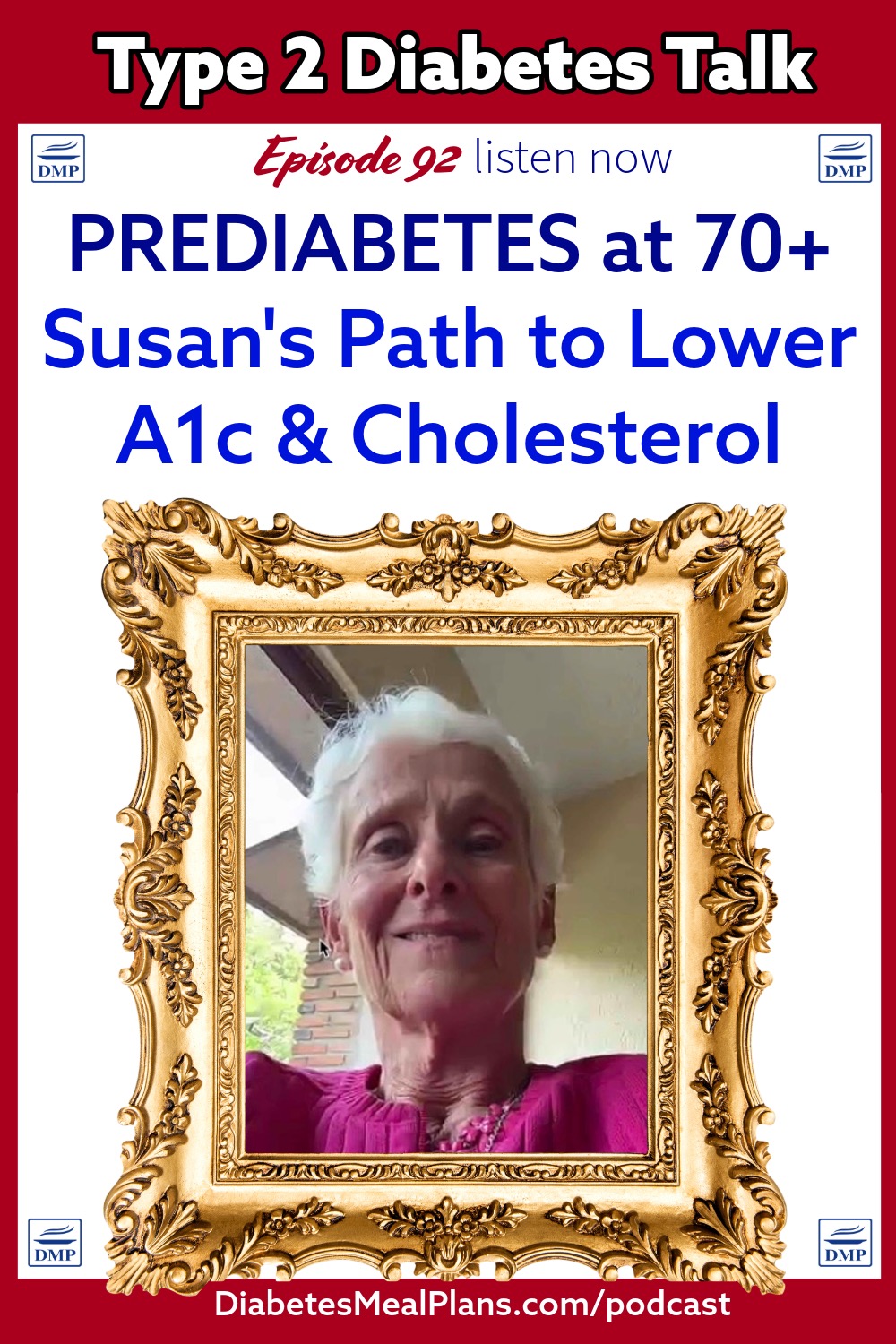
In this episode, Dr Jedha chats with Susan, a warm and thoughtful member of our Prediabetes Reset Program. Susan shares her journey of tackling rising blood sugars, shifting her mindset around food, and discovering just how valuable her health truly is.
LISTEN TO THE PODCAST
Support the podcast by leaving a 5-star rating and review on Apple, Spotify or our Website – Thank You!
Finding Balance, Patience, and Better Health: Susan’s Story
Susan, now 71, found her way into the Prediabetes Reset Program almost by chance. At the time, she’d just started on statins and aspirin for heart health, and her doctor had also asked her to keep an eye on her blood sugar levels.
Gradually, her A1c edged up from 5.5 to 5.6 and then to 6.0, leaving her feeling uneasy that she was becoming borderline diabetic.
Like many, Susan wondered if the statins were partly to blame, since cholesterol medications are known to raise blood sugar. Still, she also recognized that with age, the body doesn’t always handle things as well, and it was time to be proactive.
Joining the Prediabetes Reset Program was the first structured approach Susan had ever tried. From the start, she felt reassured by the depth of research and practical guidance.
She also appreciated that it wasn’t just about rigid rules. Instead, it offered real strategies, backed by evidence, to navigate everyday eating, something she felt was missing from so much of the conflicting information online.
Susan candidly admits she’s always had a bit of a “little devil” on her shoulder whispering, “Go on, have that ice cream.” But she’s found new ways to manage those habits without feeling deprived.
Inspired by ideas like those in the book Atomic Habits by James Clear, she’s learned to pause and ask, “How much do I really need to feel satisfied?” Now, she can enjoy a half or quarter slice of toast, rather than automatically reaching for the whole piece, and still feel content.




Through it all, Susan has discovered that mindset plays a huge role. As she puts it, it’s not about beating yourself up. It’s about slowly figuring out what works for you and being patient with yourself along the way.
She loves Dr Jedha’s motto: “Your health is your wealth.” Because without good health, it’s hard to be there for the people you love, or to truly enjoy life.
Susan’s practical approach has brought real results. By focusing on consistency over perfection and leaning into the program’s guidance, she’s lowered A1c from 6.0 back down to 5.7, with confidence she knows exactly what to do to get it to 5.5 if needed.
Her husband has joined her efforts too, dropping his A1c from 6.0 to 5.5. Together, they’ve embraced small shifts like reducing desserts and exploring satisfying meals that keep them full and happy.
Susan’s cholesterol levels have also improved, helped by letting go of the old myth that fats like butter and cheese are harmful. In fact, she’s learned that healthy fats can actually keep you fuller, helping reduce cravings.
Most of all, Susan values the steady, reliable support. Whether it’s quick answers to questions, seeing other members’ experiences, or simply knowing she’s guided by solid, research-backed information, it’s made all the difference.
Her best advice? Go slowly, stay curious, love yourself enough to experiment, and remember that small changes truly add up.
If Susan’s story resonates with you, take heart. You don’t have to be perfect, you just have to keep moving forward, one thoughtful choice at a time.
Join the Prediabetes Reset Program and experience transformational changes in your life, too!
Transcript
Click Here To View
Dr Jedha: 0:55
Hello wonderful people episode of the podcast where I chat to members of our programs who share their experiences, insights and best advice for others wanting to make a change.
Dr Jedha: 1:12
I love these chats because I love hearing about the progress of our members. With our regular member check-ins, I’m actually really lucky that I get to hear from people all the time and that’s really inspiring to know that what we’re doing is making a difference in people’s lives and, after more than a decade of doing this, you really never get tired of hearing from people supporting them to make improvements. Let’s face it, we all need support, so it’s an honor for people to put their trust in us and experience the change in their lives. Anyway, this episode I sat down for a chat with Susan, so let’s get straight into that chat now and I hope you find some fantastic gold nuggets to take away to inspire that next step in your health journey. Yeah, so basically, you get to share your story with me today, like I’m looking forward to really learning more about your journey, and so I guess maybe you can share a bit of your history and how you came to find us.
Susan: 2:30
No, I think it just popped up on one of my emails. I honestly don’t remember how I got it. I have lots of health related websites, so I don’t know. I just came up and I had just been not diagnosed. But I started taking statins and other things that will protect aspirin about four years ago and the doctors said I want you to start checking your sugar and it went from five, five, five, five, six and I thought, oh my God, I’m borderline diabetes and so he has me on a you know checking it every time, and I seem to go from six down down to five, seven. It used to be, as I say, five, five before I started taking the medicine. When I’m lazy I will say, oh, it’s the fault of the statins. Is that that’s the fault? The statins is making me do it? But you know, you also know I’m 71, so you know that it’s going to be that your body is going to maybe not react as well. But I’ve learned a lot. I am very happy that I joined your program.
Dr Jedha: 3:38
Oh, that’s great, susan. And just to point out to our listeners that statins cholesterol medications can raise blood sugar and many people don’t know that. So was this the first program you’ve actually taken?
Susan: 3:50
Yes, yes, as I say, I really and I can’t even tell you where, where, how it popped up, but I I thought you were very good. You’ve obviously done your research and you’ve got a very good program and you’re helping. You’re helping many, many people, because there are many people that you read about and there’s, what’s the statistic in the United States is how many people are wandering around with pre-diabetes and diabetes and they don’t even know.
Dr Jedha: 4:18
Oh, gosh, it’s millions and millions of people, not only living with type 2 and pre, but millions going undiagnosed. It really is pretty crazy. So, Susan, before we chat about results and your experience, I wonder have you had any struggles along the way?
Susan: 4:36
I find I still have this little rebellious, little devil in my head that will say oh yes, you can eat ice cream, and you are, you know, but I’m finding I can. Now there’s an interesting I don’t know if you’ve ever read the atomic habits by James Cleary, and there’s a little section where he’s talking to someone who’s trying to lose weight and the girl just cannot stop taking a bag of chips and starting it from the beginning to the end. And something that stuck in my head was um, whoever she was working with said how many chips does it take for you to feel satisfied? And I think that’s where I can.
Susan: 5:15
Now I I like my toast, but I don’t need to eat a whole piece of toast. I can eat half a piece of toast or a quarter of a piece of toast, so that mentally, I’m saying you’re not depriving yourself of toast, but you’re not eating the whole piece of toast or a quarter of a piece of toast. So that mentally, I’m saying you’re not depriving yourself of toast, but you’re not eating the whole slice of toast. I think that’s where my because I’ve always been very thin and everybody’s always said you’re so lucky, you can eat whatever you want, and I used to have that mentality I can eat whatever I want. But I think the hardest part has been saying to your mind yes, not to deprive myself. I’ve never been able to deprive myself of stuff that I love.
Dr Jedha: 5:50
And look, I think you’re doing all the right things. Like it is, finding those strategies that work for you as well, and it so much of it is about mindset, isn’t it? And we don’t want to feel deprived none of us do, I mean. We’ve got to have the things we love. That’s exactly why our motto is consistency is more important than perfection, because it really is. Eat well most of the time and we can still afford indulgences!
Susan: 6:13
I think the fact that you’re, you’re always saying, keep going, this is not a, you know, this is work in progress, keep at it. You know, you, you, you are learning about yourself is is your best, your bed the best, and I absolutely love your, Your health is your wealth. Because you start getting to this stage and it’s like, oh, my god, everybody’s. Lots of people are now getting sick or, you know, they’re in their 70s, mid 70s or 80s, and it’s like then kids, my children, were in their 30s and 40s. Well, you know, no, I’m fine, I’m fine, I don’t have to. You know, health is nothing without it. You can’t do without it, right?
Dr Jedha: 6:57
Certainly true, and I think the sooner we can take care of ourselves the better, because you know, we do start. The older and older we get, the more we realize that that is the truest thing, because without our health, life becomes very difficult.
Susan: 7:12
My goodness. No, I have 70-year-old friends that are not in good shape because there’s been abuse all their life with alcohol, or you know just their weight, their lack of exercise, or they’ve had injuries and can’t move, and so, yeah, it’s important, yeah.
Dr Jedha: 7:29
Yeah, yeah. So when you can you talk about, a bit about the results too, of taking the prediabetes program, what your A1C was before and after, and your husband partook in the program too.
Susan: 7:45
I have a sister-in-law in Germany and we go to visit her in Germany and who can resist the bread? Anyway, I come back from that holiday and I test it and it’s six. But then I get back on the test, you know, back on your plan, and I can get down to five, seven. Now I know if I really had to get down to five five. I feel I know now what to do. My husband was at six and he was able to get it down to five five. We know we work together. We kind of say no dessert, so we’ll have a dessert. You know we kind of work it out together, which is fine. So I feel that he’s benefited from all of this as well.
Dr Jedha: 8:24
That’s really good, working together, obviously supporting each other, and you both lowered your A1C down from around six to 5.7 for you and 5.5 for your husband, which is great. Yeah, and what about your cholesterol levels? Have they improved?
Susan: 8:41
Yes, they have definitely improved. But I think one myth that I always had was that I couldn’t eat fat. You know, like the butter and the cheeses and you know, looking at your numbers of all the charts that you’ve given us, it satisfies you greatly to have a piece of cheddar cheese with a piece of avocado or tomato or whatever. So I’m grateful for that fact because it does help to satiate and, you know, you feel fuller, you feel less hungry.
Dr Jedha: 9:10
Yep, yep, there tends to be a big fear around fat, but none of it’s true, of course. So, susan, how would you describe your experience of being a member?
Susan: 9:21
It just feels like the information that you’re giving us is well-researched and, again, for all levels. And then sometimes on Pinterest, you log in and there’s all sorts of not good information. I’m using your information as the base and I’m reading other things and I just think, no, that’s not true, you cannot have that, or it’s better if you don’t.
Dr Jedha: 9:44
Yeah, right, that’s why I call it the Wild West Web out there, Susan, oh yes.
Susan: 9:50
That’s why everything is now so based on your phone and your computer. So but you’ve got to you know, trust that the sites that you’re using are backed up by research, right and experience. Yeah, yeah, but I think yours is research-based and you know you’ve put in a lot of work into making it a good site. I have seen people go on diets and it just. They do it for two months and then it’s a crash Terrible. I think your program runs us through step by step by step. The videos are good and there must be lots of people that haven’t got a clue how to cook. I like to cook, so sometimes those procedures were like no, I can skip this. I know how to make an omelette, you know. But for many people that are willing to make that change, I think it’s important.
Dr Jedha: 10:39
Yeah, exactly. Everybody has a different skill level, and some people that do come into the program have zero skill in cooking at all, so that’s why there’s all the range.
Susan: 10:49
Yeah right, right, and it’s nothing to be scared about. I mean it’s, but you know what was, I think, very effective? How was it every two weeks that you connected and we could write in something that we wanted to read, right? Yeah, I thought that was excellent. I really did appreciate that and the fact that you answered very quickly and that we could get to see, you know, other people’s questions and what they thought. I thought that was helpful.
Dr Jedha: 11:16
Yeah, so you’re getting real-world support in the program too. It’s not just that program that you’re taking.
Susan: 11:22
Yeah, exactly. So that was I found that and that you answered so quickly. I really appreciate that.
Dr Jedha: 11:28
Yeah, I think members do really love that. Yeah, it just gives you that opportunity to ask a question, because you always have them.
Susan: 11:39
Yeah and it’s personal, it’s a way of connecting right. It sort of makes it a little bit more personal, Exactly that. You know that you’re just answering my questions, but I get to see everybody else’s questions, which is nice too. Yes, oh, great. But I’m very grateful for your program and I’m glad I thought the price was very good for all the information that you gave us, and I will keep at it.
Dr Jedha: 11:59
Oh, that’s great, Susan. Thanks so much for all that positive feedback. It’s so great to hear and of course we will be staying in touch with you to get future progress updates. But one more question. So what would be your best advice for other people wanting to make a change?
Susan: 12:18
What would be my best advice? Go slowly, don’t bash yourself. There is no miraculous cure. Be patient with yourself. Be aware of your own personal quirks. What makes you feel full after a nice breakfast? What makes you feel like, okay, I can do this because I ate this in the morning, so let’s just go easy in the afternoon. I think it’s more like a love for yourself and a love for health, and a love for I care about what happens to me, because my health is my wealth. Without my health, I can’t be a good grandmother. I can’t be good to anyone. I would say be interested in learning more, be interested in experimenting, trying things out, seeing what works for you and be patient with yourself. But know that if you don’t, you know if you keep doing all the bad things, nothing’s going to change. I mean, you’re not doing the bad thing, if you keep with old habits of just only 10 chips, not 100.
Dr Jedha: 13:36
So I hope you enjoyed that chat I had with Susan. It really was wonderful to catch up with her and share some of her story and experiences. She’s given us so many valuable insights from how important it is to take it slow and not beat yourself up, to being patient and curious about what works for your body. I really love how she put it. It’s about having a genuine care for yourself and recognizing that your health truly is your wealth. That’s the email signature I always use: your health is your wealth, because it really is.
Dr Jedha: 14:15
But what’s important is, at the end of the day, it’s not about chasing perfection. It’s about building awareness, continuous learning and that includes ongoing learning about ourselves and our habits, finding practical strategies that suit you and staying consistent most of the time, because that’s what leads to lasting change. What leads to lasting change. So if Susan’s story has inspired you, remember you have the power to take that next small step and we’re here to support you every step of the way.
Thanks again for tuning in and until next time, take care and keep prioritizing your health.
Dr Jedha, over and out.
Subscribe to Type 2 Diabetes Talk on: Apple | Spotify | Amazon Music | Audible | YouTube | Podcast Index | Player FM | and more…
Leave a Reply