


If you’ve ever felt like you’ve been left on your own to figure out how to manage type 2 diabetes or prediabetes, you’re not alone.
In fact, that very problem is what led me — Dr. Jedha — down a 15-year journey to uncover what truly works, and to prove it through world-class research. In this episode I revisit that journey and my gold-standard T2Diet research.
LISTEN TO THE PODCAST
Support the podcast by leaving a 5-star rating and review on Apple, Spotify or our Website – Thank You!
What Sparked The DMP Mission
Early in my career, I was working with clients on weight loss who also struggled with blood sugar control. When I went searching for reliable guidance to help them, I found little more than recycled advice: eat less fat, count your calories, follow the outdated food pyramid.
Not only was it confusing, it simply didn’t work. I remember thinking, If I had diabetes, I’d be completely lost. That moment lit a fire in me. I wanted to change it, not just for my clients, but for anyone trying to lower blood sugar naturally.
That’s what led me back to university to earn a Master’s degree and then a PhD. Along the way, I wasn’t chasing letters after my name; I was chasing the truth about how food could be used as a genuine treatment for type 2 diabetes. Not in theory, but in a way that people could actually use in their everyday lives.
This mission eventually led me to create Diabetes Meal Plans (DMP), which began as a small website sharing practical, evidence-based strategies. It quickly grew, because it worked.
People were lowering A1c, losing weight, and finally stepping off the frustrating cycle of trial and error. But seeing all those success stories made me even more determined to prove it scientifically.
World-Leading Diabetes Nutrition Research
When I started my PhD research in 2019, I was honestly shocked by what I found. Despite type 2 diabetes being one of the most common chronic conditions worldwide, there was almost no rigorous research on how digital nutrition programs could help.
I conducted a systematic review of all the randomized controlled trials (RCTs) I could find, and discovered only 16 studies that included a dietary component. Of those, just two actually measured changes in people’s diets. It was a huge gap.
So I set out to create something different: a fully structured online nutrition program specifically designed for people with type 2 diabetes, using a low carbohydrate dietary approach.
While there were a couple of single-arm low-carb studies out there, none had undergone a full-scale RCT, and none were co-designed with the people who’d actually use them.
The T2Diet Program was built from the ground up with real people’s input, grounded in behavioral science, and meant to be practical, flexible, and truly supportive.
It took over a year to build. Then we tested it in a rigorous RCT with 98 participants. Half received standard medical care, while the other half received standard care plus the T2Diet Program.
Results of the T2Diet Clinical Trial
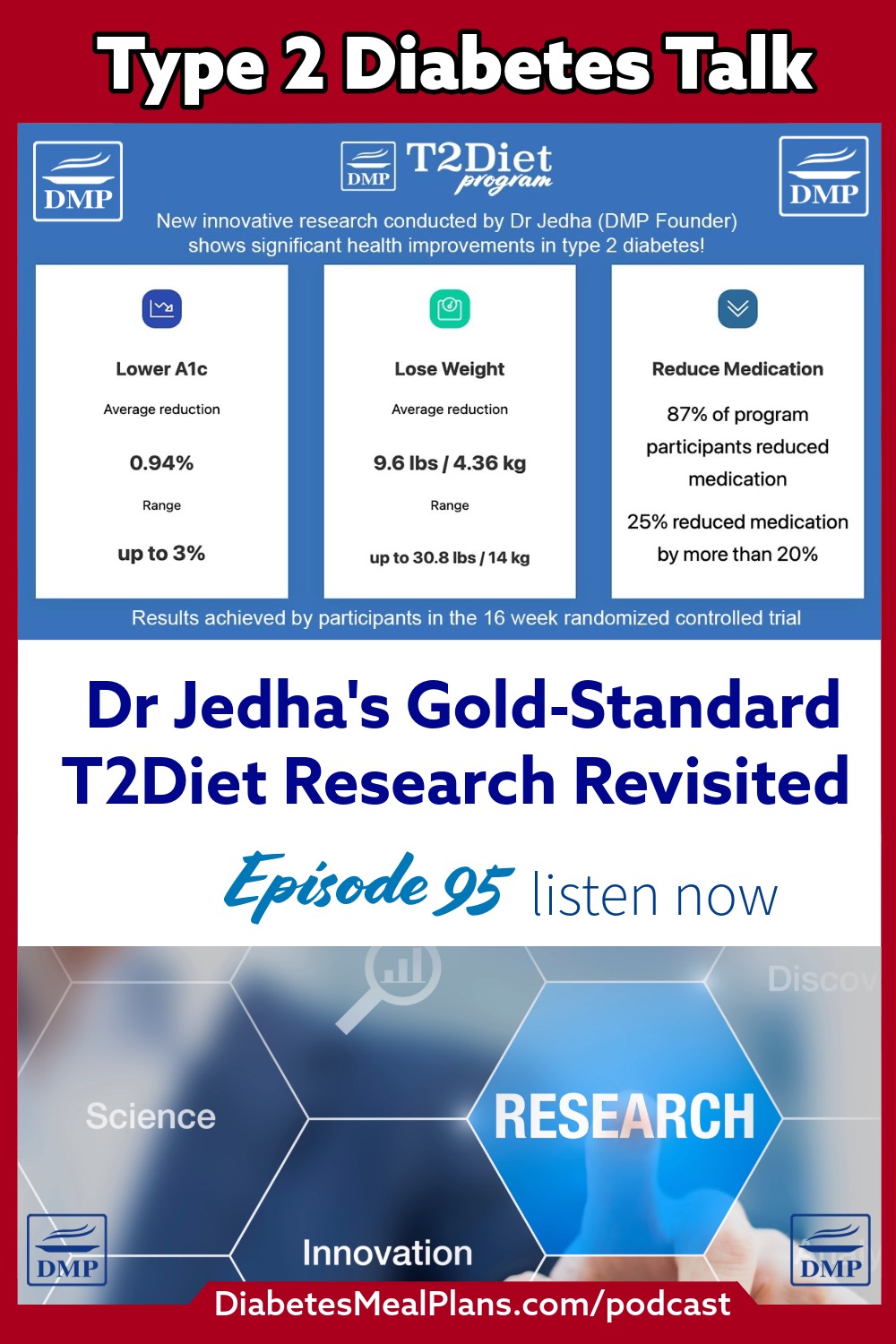
The results were remarkable: in just 16 weeks, people in the program reduced their A1c by nearly 1%, lost an average of 9.6 pounds (4.36kg), and 87% reduced their diabetes medications, with 25% cutting their meds by at least 20%.
Meanwhile, the standard care group saw only minimal changes and even increased their medication use. These findings were published in Nature’s Nutrition & Diabetes journal.




Beyond the clinical outcomes, we also uncovered why the program worked. Unlike most digital health tools, which often have low engagement, 80% of participants in our study stayed fully engaged.
Through interviews and data, we found that the program’s structure — step-by-step guidance, manageable lessons, regular reinforcement, and tools shaped by real user input — made all the difference. People didn’t just learn; they took action, saw results, and built lasting habits.
Even more importantly, the story didn’t end with the study. The T2Diet Program continues to change lives every single day through our platform at DMP. Thousands have completed it since the trial, from people in their 60s and 70s to those who’ve lived with diabetes for decades.
Many have lowered A1c by two or three points, reduced or stopped medications, and finally understood exactly what to eat, and why it works. We’ve even adapted it for people with prediabetes via the Prediabetes Reset Program, who are reversing prediabetes numbers back to normal in just a few months.
So if you’ve ever felt stuck, frustrated, or overwhelmed by conflicting advice, know this: there is a proven path forward. It’s not just theory. It’s real. It’s backed by science. And it works.
If this sparks even a small sense of hope or curiosity in you, I encourage you to explore the T2Diet Program or Prediabetes Reset Program and start changing your health today.
Or, if you’re already a member, revisit the resources with fresh eyes, knowing just how solid the evidence is behind what you’re using.
Because at the end of the day, it’s not about the research papers or the awards. It’s about helping people like you take back control and feel empowered!
Transcript
Click Here To View
Dr Jedha, Host
Hello, Dr Jedha here, and thanks for joining me today.
Now, you might’ve heard me mention the T2Diet Program before, or maybe you’ve even been part of it, but what you may not know is just how much science, sweat, and soul went into creating and validating it. So today, we’re revisiting the gold-standard research behind the program – behind everything we do at DMP, a journey that’s taken years of work, led to global publication, and most importantly, helped real people achieve real results.
This episode isn’t just about what the research showed, it’s about why it still matters today, and what it means for you if you’re navigating life with type 2 diabetes or prediabetes.
So, grab a cuppa, take a walk, or just settle in, because whether you’re new here or a long-time listener, I hope this story shows you that real change isn’t just possible, it’s proven.
People often ask me how I ended up doing a PhD in nutrition for type 2 diabetes, especially focused on digital health. And honestly, it all started with a problem I just couldn’t ignore.
About 15 years ago, I was working with clients on weight loss, and many of them also had type 2 diabetes or prediabetes, struggling with their blood sugar. And when I went looking for resources to help guide them, I found almost nothing of value. Just the same recycled advice over and over again: eat less fat, count your calories, follow the food pyramid. Not only was it outdated, but it was also confusing and often completely wrong – and clearly, and none of it was helping.
I remember thinking, if I had diabetes, I’d be completely lost. That moment changed everything for me. I knew I had to dig deeper and find better answers, not just for my clients, but for anyone out there trying to manage their blood sugar naturally. It lit a fire in my belly. I wanted to change that. I wanted to give people real answers, backed by science, that actually worked in real life.
So I went back to university and got serious about research. First a Master’s degree, then eventually a PhD. And along the way, I wasn’t just collecting credentials, I was searching for truth. I wanted to understand how food could be used as treatment. How effective it could be and how natural strategies could help. Not in theory, but in real life. Something people could actually use.
That’s what eventually led me to create Diabetes Meal Plans, or DMP. When I started DMP, it was a small website sharing practical tips and evidence-based nutrition strategies. But it grew fast, because I was sharing stuff people didn’t really know and the approach worked. People were lowering their A1c, losing weight, feeling better, and finally getting off the rollercoaster of trial-and-error. The more people we helped, the clearer it became: nutrition is the key to improving type 2 diabetes and prediabetes, and yet it’s the part that most people are given the least support for.
The more success stories I saw, the more determined I became to prove it, not just anecdotally, but scientifically. Because when it comes to managing diabetes, food is the most powerful tool we have. And when you’re given the right knowledge and support, it can truly change your life.
So that gap, between what we know can help and what people are actually being offered – usually no education or support other than prescribing medication, that’s what drove me into research in the first place. Not to collect letters after my name, but to prove what I already knew deep down… that food is the most powerful treatment tool we have. And the right kind of support can change lives.
When I began my PhD in 2019, I was surprised, and honestly, a little shocked, by how little research had been done on digital nutrition programs for type 2 diabetes. We’re talking about one of the most common chronic conditions in the world, and yet at the time, there was barely any evidence on how online nutrition support could help. That’s a hard thing to believe right, especially when there are so many websites and so many things out there on the wild west web.
So one of the first things I did was conduct a systematic review. This is where you look at all the randomized controlled trials, or RCTs, that have been done on a specific topic. RCTs are considered the gold standard in research because they’re designed to clearly show what works and what doesn’t. And when I looked at all the online programs that included a diet component for type 2 diabetes, I found just 16 studies. And out of those 16, only two had even measured what people were actually eating or how their diet changed, only two!
That was a turning point for me. I already knew food mattered, but now I could see that we had almost no solid evidence on how digital programs could deliver dietary support effectively. That gap needed to be filled.
So I got to work developing something different, a fully structured online nutrition program designed specifically for people with type 2 diabetes, using a healthy low-carbohydrate nutrition approach. While there had been a couple of low-carb programs tested in single-arm studies, none had gone through a rigorous randomized controlled trial, and none had been co-designed with the people who would actually use it. That’s where the T2Diet Program stood apart, it was built from the ground up by following a user-centered process. It’s grounded in behavioral science. In fact, there are lots of intricate ways in which the program influences people’s habits, mindset and actions positively through the behavioral elements embedded throughout. These are not things you can see of course, but they are very impactful. And of course, the program was designed to be practical, flexible, and supportive in real life.
After that, I moved into the clinical trial phase, a full randomized controlled trial testing whether the T2Diet Program, delivered online, could actually improve clinical outcomes like A1c, weight, and medication use. Participants were split into two groups: one group received standard medical care, and the other group received standard care plus access to the T2Diet Program.
And the results were clear: the group using the program significantly outperformed the standard care group. On average, they reduced their A1c by nearly 1% though some people by as much as 3%, they lost 9.6 pounds (4.36kg), and 87% reduced their diabetes medications, with 25% reducing their meds by at least 20% – that’s just in 16 weeks. Meanwhile, the standard care group barely moved the needle and actually increased medication use.
One of the most important parts of the research wasn’t just the clinical results, it was understanding why the program worked.
Most digital programs have pretty low engagement. People drop off, lose interest, or feel overwhelmed. But in the T2Diet Study, 80% of participants followed the program as expected, a much higher rate than we typically see in digital health. In fact, the level of engagement was huge. That told me something was different here.
To find out what that was, I went deeper. I looked at the data for how people used the site; but more importantly, I interviewed participants after they finished the program. I wanted to understand what influenced their experience, was it what they learned, how they felt, or the actions they took that really made the difference?
And what came through was clear: people found the program useful, credible, and practical. They weren’t just learning information, they were applying it, seeing results quickly, and feeling motivated to keep going.
A big part of that came down to how the program was structured. It gave people step-by-step guidance, delivered in manageable chunks, with consistent reinforcement and reminders. That reduced the sense of overwhelm that so many people feel when trying to manage diabetes. It wasn’t about doing everything perfectly, it was about making small, meaningful changes that built momentum over time.
And because the program was designed with input from real people with type 2 diabetes, it met them where they were. The tools, the resources, the language, it all felt relevant. That sense of being understood and supported really helped people stay engaged and empowered.
Another big driver of success was the rapid feedback people experienced from their own health. As blood sugar levels dropped, weight came off, and medications were reduced, people saw for themselves that what they were doing was working. That’s powerful. When you see results with your own eyes, it shifts your mindset, from frustration and confusion to confidence and motivation.
And for the first time in research, we were able to document these behavioral insights in a digital dietary program for people with type 2 diabetes. That final phase of the study was published, and it added a whole new layer of understanding to what makes digital programs successful, not just clinically, but personally.
With the number of websites you see and all the noise on social media, you might think, with how far we’ve come in digital technology, that programs like this would now be common. But the truth is, they’re still incredibly rare.
Even today, most people with type 2 diabetes aren’t being offered structured dietary support, let alone access to a clinically proven, evidence-based nutrition program. And if you search online, what you’ll mostly find are unproven plans, generalized advice, or flashy marketing from programs that have never been tested in a real scientific setting.
That’s why this research still matters, because it filled a critical gap that no one else had addressed. The T2Diet Study wasn’t just another diet trial. It was the first online diabetes nutrition program to document co-design with real people’s input. It was the first to test a low-carbohydrate approach delivered completely online, in a randomized controlled trial, specifically for people with type 2 diabetes. It was the first to assess people’s engagement and experience of the program. And it showed, without a doubt, that when you give people the right tools and support, they can improve their blood sugar, lose weight, and reduce their medications, all from home.
This is especially important as healthcare systems become more stretched, and more people are looking for alternatives to clinic-based care. The demand for accessible, effective, and affordable solutions has never been greater. And yet, the options out there are still far behind what the evidence supports.
So when you hear me talk about the T2Diet Program and the research behind it, it’s not to pat myself on the back. It’s because people deserve better. You deserve better. You deserve to know that there is a proven way forward and that your health doesn’t have to be left to guesswork or outdated advice, which unfortunately out there on the wild west web, continues to happen.
What’s most rewarding to me is that the impact of this research hasn’t stopped at the multiple publications. It’s continuing every day through the T2Diet Program, now available to our members through our platform at DMP.
Since the study finished, people going through the T2Diet Program continue to experience real change. I’m talking about people of all ages, people in their 60s and 70s and people who’ve been living with type 2 diabetes for 20 years, who’ve been able to drop their A1c by two, three or four percentage points and reduce or come off meds. People who’ve finally lost the weight they’ve struggled with for years. People who’ve said things like, “This is the first time I’ve actually understood what to eat and why it works.”
After completing the study I also revised the program for people with prediabetes and that’s just been incredible to watch. Most of our members are reversing their prediabetes in 4-6 months, back to normal glucose levels and sustaining that.
That’s what keeps me going, knowing the science we developed isn’t just sitting on a shelf somewhere, like most research does. It’s being used, every single day, to help people take back their health in a natural, sustainable way. And, we continue to develop our resources and membership to offer high quality support that truly does change people’s lives.
As I look back on everything I’ve done – from that small fire that was lit in my belly 15 years ago, to the creation of DMP and everything it took to complete this research, the years of study, the endless late nights, the burnout, the breakthroughs, can honestly say, it was all worth it. It IS all worth it. Every single day I continue to research and explore the science to make it practical for you. Every day I continue to build on our members’ resources. Because at the end of the day, it’s not about the publications or the data points. It’s about the people whose lives have changed because of it. The people’s lives we can change in the future – that’s powerful, and it’s so rewarding.
I’ve heard from so many members who’ve lowered their A1c, lost weight, come off medications, and finally felt in control of their health — many for the first time in years. We’ve shared many of their stories on this podcast too – Wilma in episodes 7 and 36, Dean in episode 31, a range of stories in episode 25, Lisa in episode 61, Paul in episode 72, Jeanette in episode 88, Susan in episode 92, and all the many testimonials on our website, they are all from real people.
This isn’t just theory. It’s real. It’s proven. And it works.
So if today’s episode sparked something in you, I encourage you to take the next step. Explore the T2Diet Program and start on a journey to change your life today – we can provide real support to do that. Or, if you’re already a member, revisit some of the materials with fresh eyes, knowing just how much evidence backs what you’re using, just how much evidence is embedded throughout all of our resources, the guides, the healthmaps – all of it is backed by solid evidence on what actually works. Visit the monthly member check ins to get extra help. Send in your quarterly health update when you get those emails, because this is your opportunity to get personal one-on-one feedback on something or to troubleshoot issues. Refresh your commitment to YOU, because we’re certainly not going anywhere – we’re here to support you.
And I just want to say, thank you to all of our members, for choosing us to be there to support you, for putting your trust in us – we’re truly grateful for that, for letting us be part of your life so we can help make a difference.
Thank you for taking the time to join me today and allowing me to share this part of the journey with you. I hope it’s helped you feel more confident, more informed, and more empowered, because that’s what this work and my mission has always been about.
Until next time, take care of you.
Dr. Jedha, over and out.
Subscribe to Type 2 Diabetes Talk on: Apple | Spotify | Amazon Music | Audible | YouTube | Podcast Index | Player FM | and more…
Leave a Reply