


Table of Contents[Hide][Show]
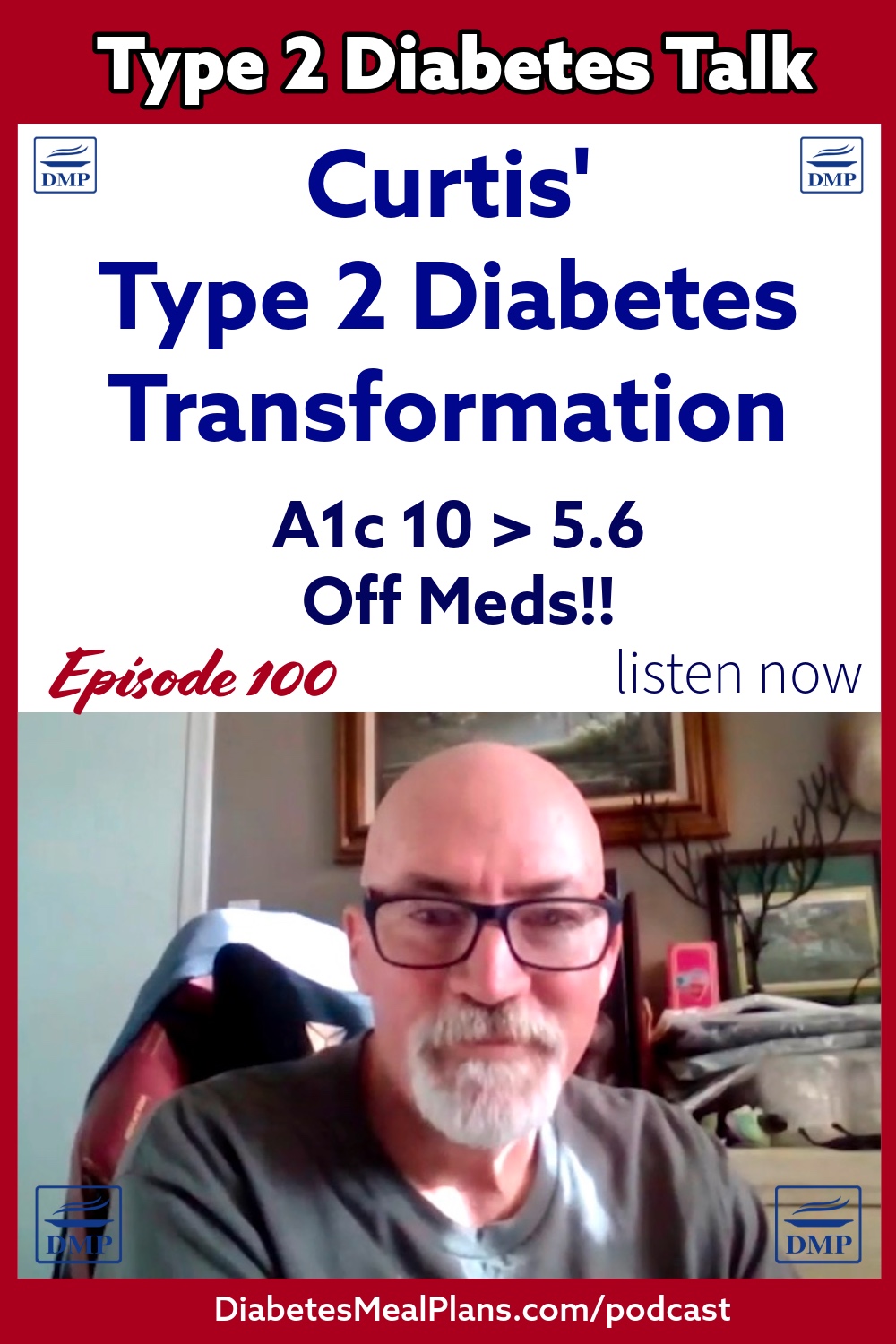
Reaching 100 episodes of Type 2 Diabetes Talk is a milestone worth celebrating, and today’s story captures why we do this work. Curtis lived with type 2 diabetes for more than a decade and even had a heart attack followed by triple bypass surgery, until he reached a crossroads that pushed him to search for better answers, which led him to the podcast, then to our program, and ultimately to a very different life.
In this episode, Curtis shares his story, plus Dr Jedha chats about why small steps lead to big changes. This 100th episode is nothing short of inspiring!
LISTEN TO THE PODCAST
Support the podcast by leaving a 5-star rating and review on Apple, Spotify or our Website – Thank You!
Overview
Despite living with type 2 diabetes over 12 years and a heart attack, Curtis’ the real wake-up call came when his vision began to blur.
After Curtis joined as a VIP Member, he made small, steady adjustments and kept stacking them. He learned what different foods did to his blood sugar. He swapped high-carb staples for lower-carb alternatives, like zucchini noodles instead of pasta.
He and his wife shifted toward cleaner eating, minimizing processed foods and seed oils. He tracked his readings, paid attention to patterns, and used those insights to make better choices the next day. And when he did indulge, he got right back on track without guilt or drama.
The results speak for themselves. In around nine months, Curtis reduced his A1c from 10.0% to 5.6%. His fasting glucose fell from 204 mg/dL (11.3 mmol/L) to 86 mg/dL (4.8 mmol/L).
His total cholesterol dropped from 274 to 147, and his LDL moved from 197 down to 74. He lost 36 pounds (16.3 kg).
He came off metformin completely after previously taking 2,000 mg per day. His cardiologist removed one blood pressure medication and halved the other. Beyond the numbers, he reports better sleep, more energy, and improved gut health.
What changed? Not perfection. Consistency.
Curtis describes it as a series of cleaner choices, one meal at a time. He focused on food substitutions he could enjoy, not a list of “can’ts.” He practiced saying “not today” to cookies when it mattered.
He kept a close eye on his readings to confirm what was working. And he anchored everything to a clear why, he wants to be around, healthy and active, for his granddaughter.
That why matters. Motivation fades fast when it’s vague. A specific reason turns tough decisions into easier ones: prep dinner, not takeout; protein and non-starchy veg first, not a bowl of pasta; a short walk after meals, not the couch. When your choices tie into something deeply important, consistency becomes far more doable.
Curtis also points to support as essential. He leaned on education he could trust and a community where real people share real struggles and wins. He didn’t try to reinvent the wheel. He learned from others who’d already walked the path and adapted those lessons to his own life.
That’s the beauty of a step-by-step approach, you apply one change, watch your numbers respond, and then build from there.




Takeaways from Curtis’ story
If you’re starting out, here are a few takeaways from Curtis’ story:
Make your next choice a good one. Don’t wait for Monday or the “perfect” plan. Pick one thing you can repeat most days and begin.
Track key numbers. Check fasting glucose and post-meal readings, then notice which foods and portions move the needle. Use that feedback to fine-tune.
Swap, don’t just subtract. Replace pasta with spiralized zucchini or spaghetti squash, trade breaded or battered foods for grilled, choose olive oil or butter over seed oils, and build meals around protein and non-starchy vegetables.
Expect imperfection. If you have cake at a party, enjoy it and get back to your usual pattern at the next meal. Consistency beats all-or-nothing thinking.
Know your why. Write it down. Keep it visible. When willpower dips, your why carries you.
Small steps really do create big changes!
Curtis didn’t find a magic bullet. He built momentum by repeating simple, effective habits that his body responded to, habits he can live with. The outcomes were rapid at first and then kept improving: better glucose control, lower medications, healthier lipids, more energy, and a renewed sense of what’s possible.
If you’re ready to move from information to action, don’t go it alone. Learn from those who’ve walked the path – JOIN US AS A MEMBER TODAY!
You’ll surround yourself with support, and we’ll help you commit to a few small, repeatable steps. That’s how you turn a rough starting point into a success story you’re proud to share!
Transcript
Click Here To View
Curtis: 0:10
You, I want to say you have saved my life.
Dr Jedha: 0:13
Wow, for someone to say that to you. That’s a privilege. The fact that I’m able to be a part of people’s lives and make a real difference, that’s an honour, and the story and insights we have to share in this 100th episode of the podcast is nothing short of inspiring.
Dr Jedha: 1:07
Hello wonderful people. Dr Jedha here and thanks for joining me for the 100th episode of Type 2 Diabetes Talk 100. What a milestone and what an episode we have in store for you today. When I initially planned out this episode, I wanted to emphasize the importance of taking small, consistent steps. It’s something we encourage a lot with our members. Consistency over perfection, consistency over perfection because the plain and simple truth is consistency matters most. No matter what your goals, consistency is more important than perfection. Later today we’ll chat more about this, but fortunately, today we have a real life story to share that clearly displays the impact of taking small, consistent steps. In fact, I’ve met with a few members recently who’ve shared incredible stories, so we’ll have those stories appearing in future episodes.
Dr Jedha: 2:10
Today we’re hearing from Curtis, who I met up with in mid-September 2025. Just putting a date stamp on that, as I’m sure we’ll have many people listen to this in days, weeks and perhaps even years to come. From living with type 2 diabetes for over 12 years, a triple bypass, to losing his eyesight, Curtis shares how he has completely changed the trajectory of his health in just nine short months. It’s so inspiring. So let’s hear from curtis now. Curtis now, lovely to see you. Yes, ma’am, nice to meet you. Yeah, you too. I’m so excited to learn about your story because the reports you’ve had in the check-ins have been fantastic and it sounds like your life has improved a lot, curtis.
Curtis: 3:04
Oh, very much so.
Dr Jedha: 3:06
A good place to start is, I guess, thinking about way back to where your journey began. I mean, you said you had an A1C of 10% at one stage.
Curtis: 3:16
November of 2024, 10%. I’d had a heart attack and triple bypass five years ago and you would think after a scare like that it would wake you up. And I’ve been dealing with my diabetes for probably 12 plus years and I kind of thought back when I started this journey that most of the doctors really didn’t. They just pushed a new medication on every time I’d go in for blood work. They wouldn’t explain everything. It wasn’t until March when I changed. You know, I was looking for a primary and I asked my cardiologist and he gave me a recommendation. And between the two of them they’re just they’re they, they work together and they’re such a great team and they’ve actually really educated me, explained what my body is doing, not doing what the medication that I was on would be doing.
Curtis: 4:15
But a lot of the motivation was my vision. I mean, I’ve worn glasses for 20 some odd years but my vision was starting almost daily, sometimes changing, you know, and and that really that’s kind of what kicked me in gear that time. It was like I got, I got to change something, you know, I and I knew my numbers. Um, I would test every now and then and they’d be in the two hundreds, you know. Uh, at one point it was like two 74 one day and it was like this has got to stop.
Curtis: 4:45
It was early March. I drive a lot. I searched on my for a podcast. I had two diabetes and your podcast came up and actually you’re, the first one I listened to was the one about potatoes and that, really, that really got me thinking and it was like wow, I didn’t realize that, you know, and it, through the next several it’s like that woke me up to realize what am I eating, you know, and how does that affect my body? I probably listened for another couple weeks and then enrolled in your program yeah, so basically it was your eyesight going that really triggered that.
Dr Jedha: 5:30
You’d had a a hard event and you still didn’t trigger you to take action. But all of a sudden, after years and years of living with diabetes, you thought I need to do something yeah it, it was.
Curtis: 5:43
That was my awakening moment.
Dr Jedha: 5:47
Yeah, so basically you found the podcast and you joined as a member not long after that, but what was your lifestyle like before that, like your eating plan and stuff like that?
Curtis: 5:57
My wife’s a big meat and potatoes girl. You know, over the last several months it’s been educating. It’s like I would. You know steak potatoes, my wife loves pasta. I would still think that I was doing things better. You know, low fat, fat free, you know. No, you know now that, now that I have educated myself, that’s. It’s false. This journey is just, you know, realizing food substitutions. That’s what I’ve learned from what I used to eat and there’s so many good food substitutions out there. I mean, my wife has really supported me a hundred percent and she’s gotten on also Spaghetti. When she makes spaghetti we do the spiral zucchini now as a substitute for the pasta. We’ve also gone into clean eating, getting rid of a lot of the seed, oils and stuff, the natural flavor stuff.
Dr Jedha: 6:57
So you’ve changed quite a lot of things. It’s great too that you’ve really just dived into it, I guess. And how has being a member helped you on your journey?
Curtis: 7:07
You know I had to get to trust you, trust your information, but that was fairly easy. Doing some more research from what’s on your library, what you talked about on your podcast yeah, the Wild West web out there. You know you can go down some mud, some deep holes there. It came down to practice what you say to do and seeing the results, uh, and and, and tracking my numbers. You know, knowing that if I have this it’s going to do this to my blood work, and and, of course, the loss of weight and and you know, you know the follow-up blood works it’s been going through. That’s what’s helped me with being a member. You know, just the proof is in the pudding.
Dr Jedha: 7:54
Yeah, seeing the results come on and it happens fairly quickly and slowly at the same time it’s interesting. You get those initial results, you can see numbers changing and that provides the motivation. Maybe you can share where you started. You said at 10. But what are your numbers like now? Can you share across the board, say your a1c, your blood glucose, weight, etc my weight, uh, in november was 195.
Curtis: 8:21
Yesterday I was at 159 pounds a1c. Uh, my last blood work, august 1st, was 5. Yesterday I was at 159 pounds A1c. My last blood work, august 1st, was 5.6. Both the cardiologist and doctor took me off the metformin. I was at 2000 milligrams a day. I’ve been doing some supplements, berberine to help possibly. I mean, that was my one goal for this year is to get off metformin totally and I’m just so happy that I’ve got that one off that checklist. Cholesterol LDL total cholesterol went from 274 to 147. Ldl 197 to 74. Glucose was 204 to 86.
Dr Jedha: 9:08
Wow, that were your averages for glucose, or was that?
Curtis: 9:11
fasting glucose. That was fasting 86.
Dr Jedha: 9:14
Fantastic. So basically all your numbers are in the normal range now.
Curtis: 9:21
They are.
Dr Jedha: 9:23
How incredible.
Curtis: 9:24
Because I’m a heart patient. My cardiologist wants me to get the LDL below 74. That’s okay, I’m getting there.
Dr Jedha: 9:34
I think he must be happy, or he or she. Your cardiologist must be happy. From 197 down to 74 already with the LDL, yes and wow. I mean you just must be feeling a lot better as well. How do you feel in yourself?
Curtis: 9:54
I sleep better, more energy, my gut health is much better, don’t have the gastric problems I was having. I think some of that was also metformin, but I think a lot of that also dealt with what is in our foods, the processed foods. You know.
Dr Jedha: 10:13
Yeah, it’s great to hear that you have got off the metformin as well, and I know that one of your goals is to reduce some other medications. Oh, and I think you said the cardiologist took you off some blood pressure medication as well. Is that right?
Curtis: 10:26
Took me off. I was on two blood medications, took me off one and cut the other one in half. Wow, and he said basically monitor the blood pressure really close, because he says if it starts getting lower we’ll have to stop the next one.
Dr Jedha: 10:42
Hooray Gosh. That’s such an amazing improvement in a relatively short time, really.
Curtis: 10:48
I’m kind of surprised at how much it dropped in that timeframe. You and my cardiologist think alike in the fact that it’s. I think you’ve said it’s like if you want to slice a cake, have it. You’ve got to enjoy life, you can’t restrict yourself. But next day you’ve just got to get back on that wagon again and continue on your journey.
Dr Jedha: 11:14
That is totally true, because we can’t be perfect all the time. It’s an impossibility. So if we put those silly expectations on ourselves, we’re never going to live up to that. So it really is more about consistency over perfection. And it was funny because there was something that you wrote down which I noted and you said none of this happened overnight. It took small, consistent choices eating cleaner, being active and staying committed, even when it wasn’t easy.
Curtis: 11:46
I don’t want to sound pompous. It hasn’t been as hard as I thought it would be, but there are moments, it’s, you know you have to make a decision, do I? You know, if there are cookies. It’s like um, yes or no, um, and and it’s just no. You know, knowing where I was in november versus how I’m feeling and doing now, um, it makes, makes the choices a lot easier I don’t think that’s pompous to say it wasn’t as hard as you thought.
Dr Jedha: 12:20
I think what happened is you just made a decision that you had to change, and so you just went all in and went. I’m going to do this, which is great.
Curtis: 12:30
I want to be around for my granddaughter.
Dr Jedha: 12:33
Yeah Well, isn’t that a great? Why? I mean, of course you don’t you want to be around as long as you can and be able to keep up with her too. Oh yeah, oh, what a fantastic journey. I’m just so pleased that it’s made a big difference. It just goes to show, and I’m just, it always amazes me, you know, when people just take that action and how impactful it is. I mean, these stories are many among our members, but it’s great when people step forward to share because, yeah, it’s just so powerful. And I wish the whole everybody with diabetes just knew and could get those kinds of results quickly, instead of the medication model pushing that one agenda all the time.
Curtis: 13:18
No, I actually met with a doctor who was also a nutritionist in the same office as my primary and I met with her and discussed my concerns, what I wanted to do, my goals and everything. And it was not right. She I just didn’t feel she wanted to listen to me. I mean, I brought up the berberine. She’s like, yeah, some of my people take that, but it’s not going to make a difference and you know she actually wanted to increase some of the medication and it’s like, no, no, back to the other doctor.
Dr Jedha: 13:53
Yeah, it’s so unfortunate. A lot of the dieticians and nutritionists I mean somebody who reported today, even in the check-in said, yeah, they thought that the dietitian was crackers, because they’re recommending, you know, crackers and fruit and oats and when she was in hospital and look, it is pretty crackers to tell you the truth, that the lack of education or the type of education that these people are getting around diabetes, it’s just completely inaccurate. And you know, that’s why I keep pushing that message out there, because if somebody like yourself finds the podcast or our website and we can help make a difference, it really, really matters because we’ve changed your life forever and that’s what’s important.
Curtis: 14:44
Oh, big time I want to say you have saved my life.
Dr Jedha: 14:49
Yep, and that’s a wonderful thing, like that’s what makes me inspired and motivated every day. Good, so I always like to ask people what would be your best advice to people wanting to make changes in their lives.
Curtis: 15:09
I’d say managing your diabetes is a marathon, it’s not a sprint. Celebrate those small wins. Any win, no matter how small it is, they’re wins. Any win, no matter how small it is, they’re wins. Track your blood sugar readings, what you eat, how it affects it. Not only does that help me but, in discussing it with my doctors, a plan of action that we could take, especially with the medication and wanting to come off of it Support system. Leaning with the medication and wanting to come off of it Support system. Leaning on the support system.
Curtis: 15:50
I know you’ve always said that you’re available. I believe that because of the success of your program, I didn’t feel I had to use you as a crutch that much. I know I missed a couple check-ins, but it was always nice to review those. Listen to what other people are struggling with. The other thing is don’t create the wheel. There’s other people that have been out there and done this and have struggled with it. Learn off them. My why I said one was being around for my granddaughter the fewer medications, the energy levels, just my health that’s what I remember it’s like. Why am I doing this?
Dr Jedha: 16:27
Yeah, Well, what a great decision that you made, and now your life is completely different. So fantastic.
Curtis: 16:36
Thank you, doctor, I appreciate everything you do.
Dr Jedha: 16:39
Thank you, Curtis. Thank you how incredibly inspiring, right Curtis? Even after years of living with type 2 diabetes, a heart attack and bypass surgery. Well, here’s living proof that it’s never too late to make changes never. His turning point came when his vision started to decline, sparking a wake-up call. From there, he found the podcast, joined the program and began making steady, consistent changes. Making steady, consistent changes.
Dr Jedha: 17:21
In around nine months, Curtis dropped his A1c from 10 to 5.6 percent, that’s a 4.4% reduction. He’s lost 36 pounds, or 16.3 kilo, and his cholesterol and ldl have dramatically improved. He’s been taken off metformin completely. Previously, he was taking 2000 milligrams day. He’s also been taken off one blood pressure medication and reduced another. All of that is just incredible, wouldn’t you agree? But the benefits that Curtis experienced go beyond the lab results. He sleeps better, has more energy and feels healthier overall. And what’s most inspiring about all this is that he did not do this through perfection, but by focusing on food substitutions. After joining our program, he realized there are many, and there really are. There are substitutions for everything, ones we can equally enjoy. Curtis focused on cleaner eating and worked on cutting the processed foods, and he achieved these great results by staying consistent, even when it meant saying no to cookies or making a better choice the next day, and if he chose to indulge, it was back on track right away. He stayed consistent even when it was hard. Curtis shared how he celebrates every small win every one and that is very important. He tracks his numbers to stay aware. He leans on support when needed and he never loses sight of his why, being there for his granddaughter being a main priority.
Dr Jedha: 19:21
Having a why, that’s a great place to start. That’s something we spoke about in episode 36. To make lasting health changes, it’s essential to identify your motivation. Why does health matter to you? Your why provides a clear vision and fuels your commitment to making healthier choices. When Curtis has moments and we all do he thinks of his granddaughter, which provides a powerful motivation that helps drive all his decisions.
Dr Jedha: 19:53
Now, in previous member stories we’ve shared on the podcast, people have shared different whys. In episode 7 and 36, Wilma shared that her why was also her kids and grandkids, and she almost cried when her son noticed how much she was chasing after the grandkids, something she wasn’t able to do before becoming a member. In episode 61, Lisa shared that her driving motivation was to avoid taking more medications as she’d previously had breast cancer and didn’t want any more meds period. In episode 88, Jeanette shared her why being life itself, as she saw her dad’s quality of life with diabetes dramatically decline in his last 10 years, and she did not want that for herself. There are so many powerful insights in the stories that members have shared, but here’s something to note.
Dr Jedha: 20:51
None of them achieve their results by being perfect. None of them achieve their results by being perfect. We often believe it’s perfection that’s necessary to achieve results. We go out of the gate too hard, too fast, only to feel like a failure, to let ourselves down. If you aim for perfection, you may always feel let down. It may always hold you back. You may always end up in a constant yo-yo dieting pattern, a negative cycle. Think about when you completely deprived yourself of something. Did you swing so far the other way that it’s hard to get back on track.
Dr Jedha: 21:31
You don’t have to avoid things until you crack. If you’re at a party, enjoy the cake a little, that’s fine, but of course that doesn’t mean indulging every day or even all day, every day, something that’s now so common in most people’s lives. Yes, if you want your life or your health to look different. Some things need to change. You need to make room and time for that. But the reality is we’re all so fabulously flawed and human. At times we may eat out of stress, eat a little too much, get lazy and forget to prep or be organised. We’ll make excuses, make an impulse buy at the store, one that’s not a healthy treat. It’s all normal. It’s called living. As you heard Curtis say himself he hasn’t been perfect, because achieving amazing results isn’t about being perfect. Yes, when we decide we need to change something in our lives, things can get hard. We have to make choices and decisions, make a commitment to ourselves, and maybe even at times it may feel like really hard work. Well, guess what we can do? Hard things, we all can. Yes, you too, no matter where you are right now.
Dr Jedha: 22:54
Achieving and maintaining good health is a journey, an ongoing one. It’s all about learning and improving step by step. It’s about finding more ways to be consistently good enough. That adds up, even though we often expect it to. Change doesn’t happen overnight, but change does happen. If you just take small steps consistently, make a commitment and have some patience, it all adds up to big changes, and you might just surprise yourself that once you start taking those steps, they start accumulating quicker than you expected. Those small steps stack up on each other and gain momentum. Small results snowball. If you want results, start making changes that you can be consistent with so that with time they add up.
Dr Jedha: 23:50
And if you’re stuck and need help, don’t do it alone. Like Curtis said, don’t invent the wheel. You don’t need to when there are whole support systems available to you, such as our programs, that can guide you the whole way. So head to our website and join us as a member. It truly will change your life, like it has for so many other members before you, and all I can say is to our members thank you for putting your trust in me, in the DMP team and our programs, and thanks to all our listeners too. As I said at the beginning, the fact that I’m able to be a part of people’s lives and make a real difference, that’s an honour. It really is. So please share the podcast, share the membership, share these stories, because every life we can change is a life enriched for the better. That’s all for today.
Cheers to 100 episodes, and I’ll see you next week for 101.
Dr Jedha, over and out.

Subscribe to Type 2 Diabetes Talk on: Apple | Spotify | Amazon Music | Audible | YouTube | Podcast Index | Player FM | and more…
Florence
After 34 years from diagnosis till today I wonder if I have hope of coming off medications. I still exercise, have increased cholesterol level with cataracts getting worse and I am also expecting 2 more grandkids this year.
My three daughter have, with the oldest having pre diabetes now expecting a second child, gestational diabetes for the second daughter and diabetic for the youngest daughter.
Any hope?
Dr Jedha
Hi Florence, there’s always hope! We’ve seen many of our members with long term diabetes come off medications. You only have to listen to Curtis’s story here and see he changed his health after living with T2D for over 12 years. Perhaps consider joining us as a member for the steps to take to turn your health around.
laurie wilson
great podcast