


When it comes to diabetes, one of the most important numbers you’ll ever come across is A1c levels. You’ll also hear it called hemoglobin A1c or HbA1c, all these names mean the same thing. It’s a test doctors use all around the world, and understanding it can give you powerful insight into your health.
In this podcast, we’ll answer some of the most common questions about A1c: what it measures, what’s considered normal, what levels are too high or dangerous, and how medications compare with nutrition and lifestyle. By the end, you’ll have a clearer picture of what your A1c results mean and, more importantly, what you can do to bring them down naturally.
LISTEN TO THE PODCAST
Support the podcast by leaving a 5-star rating and review on Apple, Spotify or our Website – Thank You!
What Does HbA1c Measure?
Think of HbA1c as the long-term memory of your blood sugar. Every time sugar circulates in your bloodstream, some of it sticks to a protein in your red blood cells called hemoglobin. The more sugar in your blood, the more of it sticks.
Because red blood cells live for about three months, an A1c test gives you an average of your blood sugar levels over the past 8 to 12 weeks, not just at one single moment in time like a finger-prick test. This makes it an incredibly valuable marker to track how well your nutrition plan, lifestyle strategies, or treatments are working.
A1c is most often reported as a percentage, but in some countries, like the UK, it’s reported in mmol/mol.
What Is A Normal A1c Level?
Here’s where things can get confusing, because the cut-offs aren’t exactly the same worldwide.
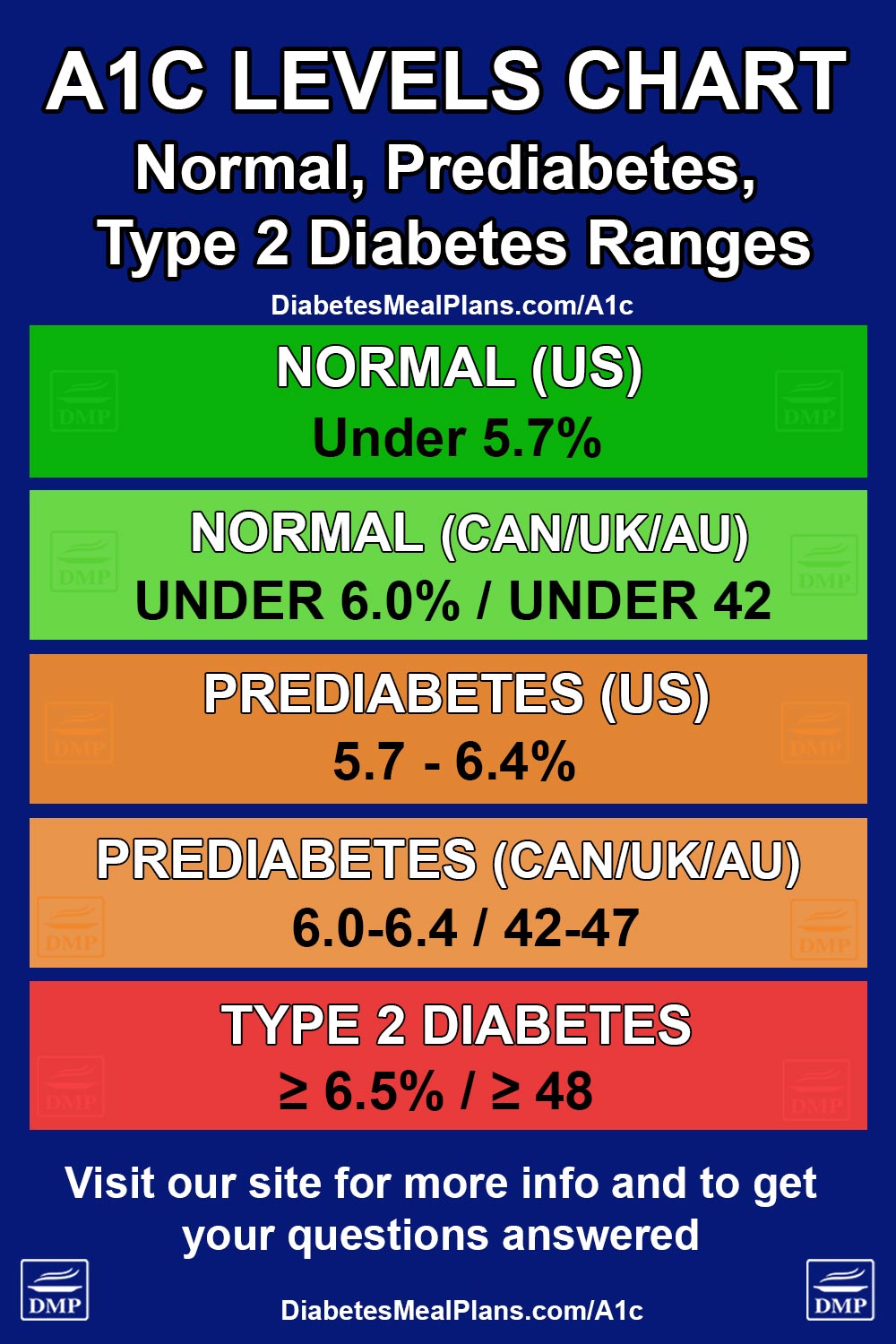
- United States: Normal is below 5.7% (under 39 mmol/mol)
- Canada, UK, Australia: Normal is considered below 6% (under 42 mmol/mol)
If your A1c is between 5.7 and 6.4% in the US, 39 to 47 mmol/mol elsewhere, that’s classed as prediabetes. At 6.5% (48 mmol/mol) or higher, it indicates type 2 diabetes, and this threshold is consistent globally.
Knowing your number gives you a benchmark, it shows not just where you are now, but where your blood sugars have been trending over the past few months.




What Is Considered A High A1c?
Any level above the normal range is technically high. An A1c of 6.5% (48 mmol/mol) is enough for a diabetes diagnosis. But the higher the number climbs, the more concerning it becomes.
For example, an A1c in the 8s or 9s reflects blood sugars running well above normal, which increases the risk of complications over time.
Many medical guidelines set a treatment target of 7% (53 mmol/mol) or below, meaning if you’re above that, your doctor will likely encourage you to bring it down.
At What Level Does Damage Start?
This is where it gets serious. Research shows that damage can begin even before diabetes is diagnosed. People with prediabetes A1c levels (5.7 to 6.4% or 39 to 47 mmol/mol) can already show early changes in their blood vessels, nerves and eyes.
Once A1c crosses 6.5% (48 mmol/mol), risks increase more significantly, and they rise sharply above 7% (53 mmol/mol). Complications such as heart disease, kidney disease, nerve damage, and vision loss become more likely the longer A1c stays elevated.
The good news is lowering A1c by even one point, say from 9 to 8, makes a measurable difference in reducing risk. Every drop matters.
What A1c Level Is Considered Dangerous?
An A1c in the 9s or 10s (75 to 86 mmol/mol) is often considered dangerous. At these high A1c levels, people may experience symptoms like excessive thirst, frequent urination, fatigue or blurred vision.
If A1c climbs into the double digits, the risks become more immediate. For example, an A1c of 12% (108 mmol/mol) means average blood sugars are around 300 mg/dL (16.7 mmol/L) every day, putting enormous strain on blood vessels, kidneys and eyes. Levels in the 12s to 15s are particularly risky and must be taken seriously.
But don’t panic, even very high levels can come down with the right changes. We’ve seen people lower their A1c from the 12s and 15s into the 6s and 7s again with nutrition and lifestyle alone. The body has an incredible ability to heal when given the right environment!
Do High A1c Levels Always Require Medication?
Not necessarily. Doctors often prescribe medication once A1c is at or above 7% (53 mmol/mol), and some may even suggest it sooner if numbers are rising quickly. But an elevated A1c doesn’t automatically mean you need medication.
For many people, nutrition changes and lifestyle adjustments are powerful enough to bring A1c down, even from the 9s or 10s.
Lowering carbohydrate intake, eating balanced meals, improving food quality, getting active, and focusing on sleep and stress management can all have a huge impact.
Metformin is usually the first drug offered once A1c crosses 6.5 to 7%, but in most cases, especially with prediabetes, medication isn’t necessary if nutrition changes are made.
Insulin is generally reserved for A1c levels above 9% (75 mmol/mol) with symptoms, but again, it doesn’t fix the root problem, nutrition and lifestyle does.
The Bottom Line
Wherever your A1c is right now, it’s not fixed. Every drop matters, and nutrition is the most powerful tool you have to move the needle in the right direction.
We’ve helped people lower their A1c from double digits back into the healthy range, reduce or come off medications, and reclaim their health by focusing on food as medicine.
Small steps, taken consistently, create powerful results.
If you’d like guidance on lowering your A1c naturally – JOIN US AS A MEMBER TODAY – you’ll find practical programs, step-by-step strategies, and the support you need to succeed.
Transcript
Click Here To View
Dr Jedha, Host
Hello wonderful people, thanks for joining me today where we’re focusing on A1c levels and some common questions that come up around it.
When it comes to A1c, you’ll also hear it called hemoglobin A1c or HbA1c. They all mean the same thing. A1c is one of the most important numbers you’ll ever come across if you’re dealing with prediabetes or type 2 diabetes, and it’s a test that doctors use all around the world.
We’re going to be covering what it measures, what’s considered normal, what levels are too high, what the A1c numbers really mean for your health and some common questions regarding A1c and medications. By the end, you’ll have a clearer picture of how to understand your results and the number one thing to focus on to move them in a downward direction.
The first question we’re answering today is: What does HbA1c measure?
HbA1c is a blood test that measures how much sugar is attached to your red blood cells. Think of it like a long-term memory of your blood sugar.
Every time sugar circulates in your bloodstream, some of it sticks to a protein in your red blood cells called hemoglobin. The more sugar in your blood, the more sticks. Red blood cells live for about three months, so the HbA1c test gives us an average of your blood sugar levels over the past 8 to 12 weeks, not just at one single moment in time like a finger-prick test does. HbA1c is a valuable marker because it shows your longer-term blood sugar trends, helping you understand whether your nutrition plan, treatment strategies or lifestyle changes are keeping your blood sugar in a healthy range.
The results of an A1c test are most often reported as a percentage, but they can also be reported in mmol/mol, which is common in the UK. And that brings us to the next question: What is a normal A1c level?
Before I share these numbers I will just say, they can be quite confusing because they are not the same all over the world. They should be, as it really doesn’t make sense that they’re not, but…that’s just the way it is.
So in the United States, a normal A1c is below 5.7%. In many other places, like Canada, the UK, and Australia, a normal A1c is considered below 6%, or below 42 mmol/mol.
Once your A1c is in the range of 5.7 to 6.4% in the US, that’s what’s called prediabetes. In many other places, like Canada, the UK, and Australia, you’ll be diagnosed with prediabetes when A1c levels are 6.0 to 6.4% or 42-47.
At 6.5%, or 48 and higher, that indicates type 2 diabetes, and that is the same all over the world.
Knowing your A1c level is important because it gives you a benchmark. It tells you not just where you are today, but where your blood sugar has been trending over the past few months.
So the next question is, what is a high A1c level?
Any number above normal is considered high, or at least higher than normal, right.
An A1c of 6.5% or higher, which is 48, is considered high enough for a diagnosis of T2diabetes. But the higher the number goes beyond that, the more concerning it becomes. For example, an A1c in the 8s or 9s means your average blood sugar is running well above normal, and that increases the risk of complications over time.
To put it into context, an A1c of 7%, or 53, is the level many diabetes guidelines use as a treatment target, or in other words, your medical doctor will likely be telling you to reduce your A1c levels to 7% or below. If your result is higher than that, it suggests your blood sugar has been elevated consistently, and it needs more attention from nutrition changes or lifestyle strategies.
So while 6.5%, or 48, is the threshold for diabetes, anything above 7%, or 53, is typically considered a high A1c that should be addressed more actively. But again, any level above normal is considered high, so you should be taking action to lower it.
And that brings us to another important question: At what A1c level does damage start to happen in the body?
Back in episode 30, we spoke about how diabetes complications develop. And look, hearing about the negative consequences isn’t fun, I know. But, it’s important to be informed and knowledgeable about the potential consequences because they are very real if they affect you. And knowing about them gives you the opportunity to take it seriously and be proactive. Anyway, back in episode 30, we spoke about how diabetes complications develop. You can listen to that whole podcast for an explanation, but briefly, when your blood sugar or A1c levels are tracking above the normal or recommended range for prolonged periods, this increases your risk of developing complications.
Research shows that damage can begin even before diabetes is officially diagnosed. Studies have found that people with A1c levels in the prediabetes range, between 5.7 to 6.4% which is 39 to 47, can already have early changes in their blood vessels, nerves and eyes.
Once A1c reaches 6.5%, or 48, the risk of complications increases more significantly. The higher the A1c climbs above that, the greater the chance of long-term problems like heart disease, kidney disease, nerve damage and vision loss. For example, risks start to rise sharply once A1c goes above 7%, or 53.
The important thing to remember is that the risk is not black and white, it increases gradually as A1c levels go up. But, it emphasizes the reason why lowering your A1c, even by a small amount, can make a real difference to your health and reduce the likelihood of complications down the track.
The next question and a serious one that comes up sometimes is: What A1c level is considered dangerous?
The higher your A1c, the greater the risks. An A1c in the 9s or 10s, which is 75 to 86, is often considered dangerous because it reflects blood sugars running at levels that can cause both short-term symptoms and long-term damage. At these levels, people may experience things like extreme thirst, frequent urination, fatigue or blurred vision.
If A1c climbs even higher, into the double digits, the risks become more immediate. For example, an A1c of 12%, or 108, means average blood sugars are around 300 mg/dL, or 16.7 mmol/L, every day. That puts enormous strain on blood vessels, the kidneys, and the eyes, and raises the chance of hospitalization for things like severe infections or diabetic emergencies. And look, I’ve seen people living with levels that high, even up in the 15s, and these levels are considered dangerous, quite simply because they put you at risk of damage to your blood vessels and the complications that arise as a consequence of that. High A1c levels do need to be taken seriously, ok.
Now, I know sometimes people are newly diagnosed and they don’t know their levels have been up in the 9s. That’s okay, take action now and you can bring these levels down. While we know an A1c of 6.5%, or 48, is the starting point for diabetes, the real danger is when numbers keep climbing or they remain unchecked for prolonged periods. Of course, the sooner you take action the better. But one important thing to know is that lowering A1c by even one point, say from 10 down to 9, or 9 down to 8, makes a measurable difference in reducing complications and improving health outcomes – we’ve seen this demonstrated in research time and time again. The important thing is don’t panic, just get proactive. Every drop in A1c matters, and it’s never too late to bring the numbers down. Get started now and work toward lower levels over time. We’ve seen people go from the 12s and 15s down to 6 and 7s again with nutrition and lifestyle alone, so we know this is possible, and research certainly shows us it is too. The body has an amazing capacity to heal and change when given the right environment. So no matter where your A1c levels are now, get started with lowering them through nutrition. And of course, if you need help to do that, head to our website for our programs and services, we can help you.
The next question we’ll answer is: What A1c level requires medication?
This question comes up a lot and in reality, there isn’t one single number where medication suddenly becomes mandatory. Doctors often recommend medication once A1c is at or above 7%, or 53, especially if nutrition and lifestyle changes haven’t been tried or aren’t bringing results. Some may even suggest starting medication sooner if blood sugars are rising quickly. Others are quick to prescribe with any diagnosis, even if it’s not really necessary.
So, here’s the important point: an elevated A1c doesn’t automatically mean you need medication. In fact, for many people, nutrition changes and lifestyle adjustments are powerful enough to bring A1c down into a healthier range, even when their A1c levels are up in the 9s or 10s. In fact, people often find that with the right approach, such as we teach people to do, following guidelines like lowering carbohydrate intake, eating balanced meals, increasing nutrition quality, being more active, and focusing on sleep and stress, all of these things help them reduce or even avoid medications altogether.
Similarly, many people ask what A1c level requires metformin?
Metformin is usually the first medication offered for T2diabetes. Doctors often prescribe it once A1c crosses 6.5 to 7%, or 48 to 53, sometimes even earlier if they believe blood sugars are heading upward. But again, this doesn’t mean you have to take it, as it’s often not necessary. Many people choose to make targeted nutrition and lifestyle changes first, and see their A1c come down without ever needing to start metformin. Same with prediabetes, for most people, while medical doctors may move quickly to prescribe, because that’s what they know how to do best, it doesn’t mean it’s needed. For prediabetes, medication is usually not necessary at all.
Another question people often ask is: What A1c level requires insulin?
From a medical doctors perspective, insulin is usually considered when A1c levels are very high, often above 9%, or 75, particularly if blood sugar is rising rapidly or if there are symptoms like excessive thirst, frequent urination, or unintentional weight loss. Doctors may recommend insulin in those cases to bring blood sugars down quickly and prevent immediate risks. Overall, we do want to prevent people going on insulin, for various different reasons. Insulin use often comes with challenges like weight gain, low blood sugar episodes, worsening of insulin resistance, and increased dependency, which is why avoiding it is a key goal. Insulin doesn’t correct the underlying problems that your altered metabolism is experiencing, which is why nutrition and lifestyle changes remain the most effective long-term solution. Once insulin is started, it can sometimes be difficult to come off, but it is possible with the right nutrition and lifestyle strategies, the right support, and with the right mindset and commitment. These are just a few factors to consider if insulin is offered as a potential strategy for you. But also an important thing to mention is that many people are able to reduce or come off insulin completely once they’ve made the right nutrition and lifestyle adjustments and with the right support, so don’t leave that out of the question either.
Another frequently asked question is how much do medications reduce A1c?
This is such an important and interesting question that doesn’t get answered a lot. I looked at this extensively when I did my PhD, because if we want to measure medication reduction in clinical trials we need to understand this and use a score to grade medication reduction. Nothing of interest to you of course, but…
For Metformin, taken at the maximum dosage, the maximum A1c reduction you’ll see is 1.5%. For sulfonylureas, like glipizide and glyburide, the reduction is similar to Metformin at 1.5% at the maximum dosage. There was some recent research that indicated sulfonylureas increase risk of cardiovascular events like heart attack and stroke. I won’t go into that here, but I’ll leave a link to that info in the show notes on our website. For Glp-1s the A1c reduction is 1.4% and for Tizepetide/Mounjaro at higher doses it can be as much as 2.5% in people with A1c levels above 8%. For SGLT-2 inhibitors, things like farxiga and jardiance, the maximum A1c reduction is 0.7%, which isn’t very much. And the same goes for DPP-4s, like sitagliptin and linagliptin, the maximum A1c reduction is just 0.7%.
Look, when it comes to medications, they can be a helpful tool at times, but they don’t have to be the first or only option. If your A1c is creeping up, it’s a sign your body needs support, and there are proven natural strategies that can help before relying on prescriptions. We know from an abundance of research that nutrition and lifestyle is far more effective than any medication. So, overall, it’s worth pursuing natural strategies before medications. And if you’re currently taking medications, you can certainly reduce and get off medications, like we support our members to do. After more than a decade of helping people, it’s clear, eating to treat diabetes is the most effective treatment option.
So wonderful people, that wraps up our A1c Q&A today. Of course we haven’t answered every question there is, so if you have a question yourself, head to our website at Type2DiabetesTalk.com to leave a message.
Here’s what I want you to take away from today: No matter where your A1c numbers are today, they can come down, and nutrition is the most powerful tool you have to make that happen.
We’ve helped people drop their A1c from double digits back into normal ranges, simply by changing how they eat. We’re helping our members every day to achieve better numbers, to reverse their prediabetes and type 2 diabetes, reduce and get off medications, as you can hear in previous episodes where members have shared their stories. And there are plenty more stories and testimonials on our website. When you focus on the right foods, balance your meals, and make steady lifestyle shifts, taking small steps forward each and every day, you’ll be amazed at what your body can do, you really will.
And, you don’t have to do it alone. If you need more practical guidance and support on lowering your A1c naturally, visit our website. That’s where you’ll find step-by-step programs, proven strategies, and all the support you need to succeed. What I do know is that you don’t want to wait for things to get worse — start using food as medicine today, and you’ll be on your way to healthier numbers and a healthier future — the choice is yours.
That’s all for today.
Dr Jedha, over and out.

Subscribe to Type 2 Diabetes Talk on: Apple | Spotify | Amazon Music | Audible | YouTube | Podcast Index | Player FM | and more…
Leave a Reply