


Table of Contents[Hide][Show]
- LISTEN TO THE PODCAST
- The Overlooked Number That May Predict Diabetes Risk Earlier
- Why Your One-Hour Blood Sugar Reading Matters
- The Key Threshold: 155 mg/dL (8.6 mmol/L)
- A New “Intermediate Metabolic State”
- What About Higher Spikes?
- Why This Matters for Prediabetes and Type 2 Diabetes
- How You Can Use the One-Hour Test at Home
- The Big Takeaway
In this episode, you’ll learn why the one-hour glucose reading may reveal early metabolic stress years before traditional tests change. And why this test is important in prediabetes and type 2 diabetes.
LISTEN TO THE PODCAST
Support the podcast by leaving a 5-star rating and review on Apple, Spotify or our Website – Thank You!
The Overlooked Number That May Predict Diabetes Risk Earlier
In this episode, you will learn about an often-overlooked blood sugar reading that research is now showing may reveal metabolic problems years before traditional tests like fasting glucose, A1c, or even the two-hour glucose tolerance test change.
It’s called the One-Hour Glucose Test, and it’s quickly becoming one of the most powerful tools for understanding blood sugar health.
Most people are familiar with checking fasting glucose or A1c. Some may have had an oral glucose tolerance test where blood sugar is checked two hours after drinking a glucose drink. But what science is now revealing is that your blood sugar typically peaks around one hour after eating, and that peak can tell us far more about how your metabolism is functioning.
Why Your One-Hour Blood Sugar Reading Matters
After you eat, blood sugar rises and your pancreas releases insulin to move glucose into your cells. The highest point of that rise usually happens close to the one-hour mark. This is when your body is working the hardest to manage glucose.
If that one-hour number is higher than expected, it suggests insulin isn’t working efficiently or that the pancreas is under strain, even if fasting glucose and A1c still look “normal.”
This is important because fasting glucose can remain normal for years while the body struggles after meals. A1c only changes after months of elevated blood sugar. And the two-hour test only shows whether glucose has come back down, not how high it spiked.
The one-hour reading captures the peak, where early metabolic dysfunction shows up first.

The Key Threshold: 155 mg/dL (8.6 mmol/L)
Across many independent studies, the same number keeps appearing.
A one-hour glucose level of 155 mg/dL (8.6 mmol/L) or above has been consistently linked to:
- Higher risk of developing prediabetes and type 2 diabetes
- Lower insulin sensitivity
- Worse pancreatic beta-cell function
- Higher blood pressure and triglycerides
- More abdominal and visceral fat
- Increased cardiovascular risk
What’s striking is that many people with readings above this level had normal fasting glucose, normal A1c, and normal two-hour glucose tolerance test results.
Researchers now describe these individuals as “high-risk normal.” On paper everything looks fine, but under the surface, metabolism is already changing.
A New “Intermediate Metabolic State”
Recently, researchers introduced the concept of an intermediate metabolic state.
These were people who didn’t meet prediabetes criteria but still had high one-hour glucose spikes. They already showed:
- Reduced insulin sensitivity
- Higher liver and visceral fat
- Worse overall cardiometabolic profiles
And once again, the one-hour test outperformed fasting glucose, A1c, and two-hour readings in identifying early dysfunction.
This reinforces what we see clinically. Blood sugar issues don’t suddenly appear. They develop gradually, and the one-hour spike is often the earliest warning sign.




What About Higher Spikes?
When the one-hour value climbs even higher, research shows stronger associations with vascular stress.
One study found that when one-hour glucose approached 190 mg/dL (10.6 mmol/L), early signs of atherosclerosis began to appear. Other studies linked elevated one-hour spikes to increased arterial stiffness and poorer endothelial function (the lining of the blood vessels).
Some research even suggests that a one-hour reading above 209 mg/dL (11.6 mmol/L) may detect type 2 diabetes earlier than the traditional two-hour test.
The spike itself is often the only sign that something is happening.
Why This Matters for Prediabetes and Type 2 Diabetes
This test isn’t just for people without a diagnosis.
For those with prediabetes, a one-hour reading above 155 mg/dL (8.6 mmol/L) indicates a higher risk of progressing to type 2 diabetes, even when fasting glucose and A1c are still normal.
The encouraging news is that people in this stage often see the greatest improvements when they make targeted lifestyle changes. Research shows insulin sensitivity improves, beta-cell function recovers, and the long-term risk of progressing to diabetes can drop by around 80%.
For those with type 2 diabetes, elevated one-hour spikes have been shown to be an independent risk factor for chronic complications, even when A1c improves. That means post-meal spikes still matter.
Lowering those spikes can help reduce stress on blood vessels, improve daily glucose stability, and lower long-term complication risk.
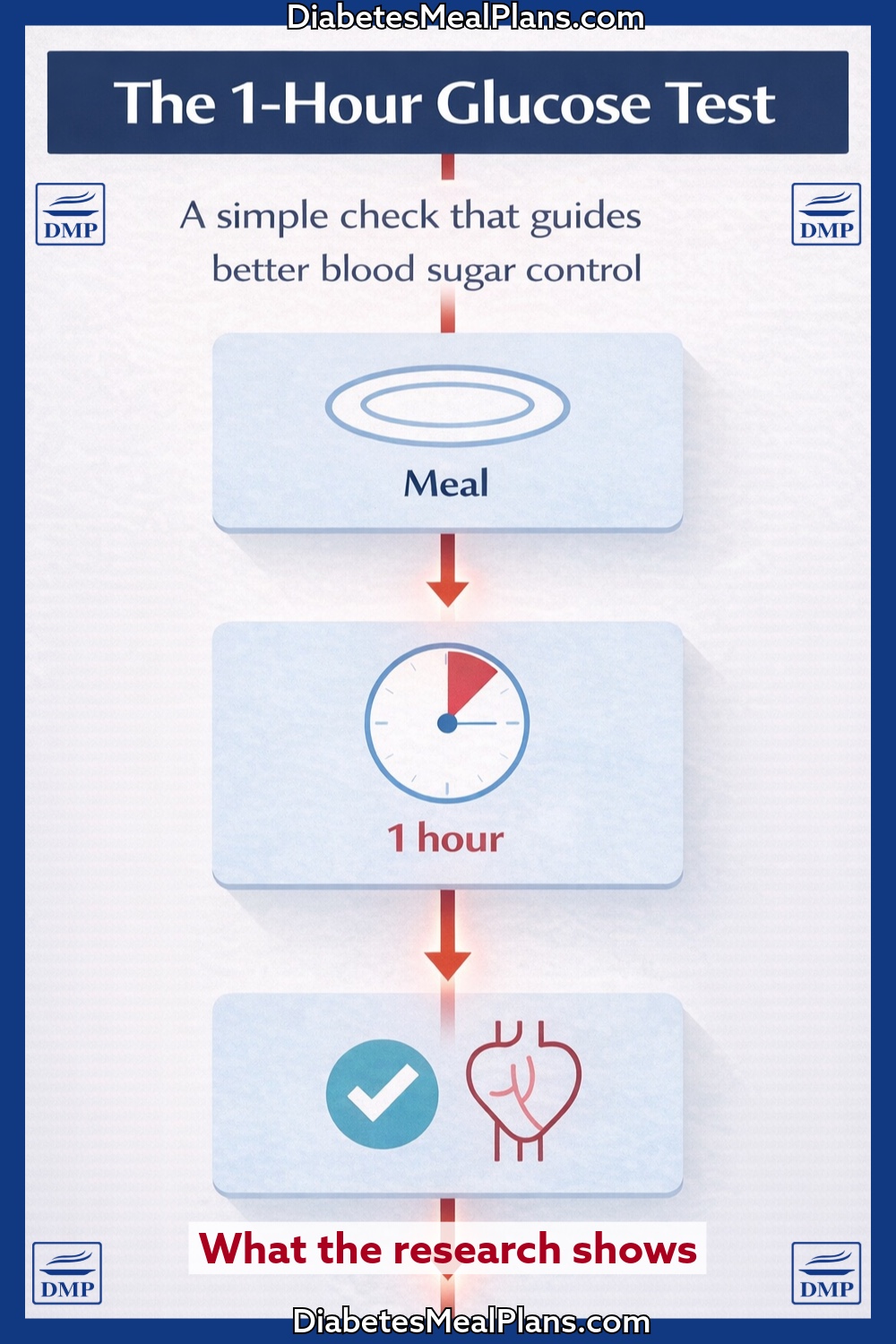
How You Can Use the One-Hour Test at Home
Simply:
- Choose a regular meal
- Check your blood sugar one hour after the first bite
- If levels are equal to or above 155 or 8.6, you need to get proactive and try to lower them.
High spikes commonly occur after carb-heavy foods such as cereals, toast, rice, pasta, sugary foods, and fruit-heavy meals.
One key step to improve your health is to adjust meals by lowering carbohydrate load, adding protein and healthy fats, improving food quality, and taking a short walk after eating.
The Big Takeaway
The one-hour glucose test can reveal early metabolic stress long before standard tests change, identify risk in prediabetes, and guide better blood sugar control in type 2 diabetes.
If you’ve ever felt something wasn’t quite right despite “normal” results, or noticed big blood sugar swings after meals, this may be the missing piece of the puzzle.
Small, informed steps can make a powerful difference.
Transcript
Hello wonderful people, thanks for joining me for episode 115.
You know, I’ve been getting so many messages lately from people saying things like, “My fasting glucose looks fine… my A1c looks fine… but something still feels off.” Or, “I checked my blood sugar one hour after eating and it was way higher than I expected, is that normal?”
And honestly, these are great questions. Today we’re exploring what I think is one of the most fascinating and important emerging areas in diabetes research: the One-Hour Glucose Test. In research you’ll hear it called “1-hour post-load glucose,” but for you and me, it’s simply your blood sugar reading one hour after a meal, or during a 75-gram Oral Glucose Tolerance Test.
And here’s why this matters. In clinical practice we focus on the two hour post-meal levels and it’s the two hour levels that get tested in an oral glucose tolerance test to diagnose prediabetes or type 2 diabetes. But there is a growing body of research that’s shown the one-hour reading can reveal early metabolic changes years before traditional tests shift. We’re talking earlier detection, clearer prediction, and a much more accurate picture of what’s happening with your insulin response.
In fact, many researchers now suggest that the one-hour value may be one of the most useful tools for identifying high-risk individuals, even when fasting glucose, A1c, and 2-hour OGTT results look completely normal. And for prediabetes and type 2 diabetes, it may also offer valuable insights to help guide you in a better direction.
So today, we’re going to break down what the science says and how you can monitor this at home to make more informed decisions about your treatment plan
Let’s start by looking at what’s supposed to happen after you eat.
Whenever you eat, whether it’s oats, a vegetable stir fry or a sandwich, your blood sugar rises and your pancreas releases insulin. And here’s the important part: your peak blood sugar typically happens close to the one-hour mark. Not fasting. Not two hours. Right around 60 minutes.
That means the one-hour reading shows the moment when your metabolism is working the hardest, the point where insulin is being pushed to handle the rise in glucose. It’s essentially a metabolic “stress test.”
If that one-hour number is higher than expected, it can signal that insulin isn’t working efficiently or that your pancreas is having to work harder than it should. And that can be happening even when fasting glucose and A1c look perfectly normal.
Traditionally, doctors and clinical tests focus on testing fasting glucose, A1c, and the 2-hour OGTT. These are helpful tests, and certainly for diagnostic purposes and monitoring, A1c remains stable. But according to surmounting research, fasting glucose, A1c and a 2-hour OGTT can miss the earliest stage where problems begin. Fasting glucose is more commonly tested, than an OGTT, because and OGTT is time consuming and more of a hassle, whereas fasting glucose and A1c can be taken from a fasted blood sample – they are easy tests. But fasting glucose can stay normal for years while the body struggles after meals. In many people, A1c only changes after months of chronic elevation. And the 2-hour test only shows whether glucose has come back down, not how high it spiked. The one-hour reading on the other hand, captures the peak glucose response, and that’s where early metabolic dysfunction shows up.
After digging deep through the science, it’s apparent that across multiple studies, researchers have noticed the same thing: people who looked completely normal on fasting, A1c, and 2-hour OGTT still had significantly elevated one-hour glucose levels. And those people were the most likely to progress to prediabetes or type 2 diabetes later on. But this test isn’t just relevant to people without diabetes. It is also a predictor for progressing from prediabetes to type 2 diabetes. And, in type 2 diabetes it can indicate higher risk of complications and heart disease. There are multiple factors why this one-hour test is strongly emerging as a potential new clinical guideline.
So let’s talk about the threshold that shows up again and again in the research, it’s 155 mg/dL, or 8.6 mmol/L.
This isn’t a random number. It’s been identified in multiple independent studies.
Here’s what researchers have found over the years:
People with 1-hour glucose above 155 or 8.6 were significantly more likely to develop diabetes over time.
Even when fasting, A1c, and 2-hour results were normal, the one-hour value was the strongest predictor of future diabetes, and the critical threshold was again ≥155 or 8.6.
Those above 155 or 8.6 consistently had:
- higher blood pressure
- higher triglycerides
- more abdominal fat
- higher BMI
- lower insulin sensitivity
- worse β-cell function in the pancreas
- and a poorer cardiovascular risk profile
This was true even when all traditional tests looked normal. That’s why researchers describe these individuals as the “high-risk normal” group. They wouldn’t receive a prediabetes diagnosis, yet their metabolic health is clearly changing beneath the surface.
Published recently in Jan 2026, another major study brought all of this research together and introduced a really helpful concept: calling this an “intermediate metabolic state.” In people with normal glucose, the early changes were already happening, and the one-hour reading was the marker that revealed it. Even more interesting, the one-hour test outperformed all other measures for identifying early blood sugar dysregulation. It was the strongest predictor by far.
I find this very interesting, as I often speak about pre and t2diabetes being an altered metabolism and the connectedness of things like high blood pressure and high cholesterol, so now researchers are seeing this test can identify and connect all of these metabolic alterations – they are all part of the same puzzle afterall.
In terms of prediabetes diagnosis, another major study suggested that the one-hour value may actually detect early prediabetes better than the standard criteria, again using 155 or 8.6 as the key cut-off.
In people with type 2 diabetes, the higher the one-hour glucose was above 155 or 8.6, the higher the incidence rate for chronic complications. All very interesting.
Now, what happens when the one-hour value goes well above 155 or 8.6.
This is where the research gets even more interesting.
A Japanese study looked at a marker of early atherosclerosis and found that when the one-hour value approaches 190 mg/dL or 10.6 mmol/L, we’re not just talking about glucose metabolism anymore, we’re seeing the earliest signs of vascular stress.
To be clear, this does not mean someone is destined for cardiovascular disease. It simply shows that glucose is spiking high enough to place stress on the blood vessel lining, something that over time could contribute to inflammation and oxidative changes.
And there has been other research showing that in terms of cardiovascular studies, even with normal 2-hour OGTT readings, people with a 1-hour value above 155 or 8.6 had:
- higher stiffness in the arteries
- worse endothelial function – that’s the lining of the blood vessel wall
- and higher long-term cardiovascular risk
Another pattern repeatedly found across studies is that people who hit 200 mg/dL, 11.1, or higher at the one-hour mark often have normal fasting and normal 2-hour values. The spike is the only sign that something is happening.
In fact, several studies show that the 1-hour value may detect type 2 diabetes earlier than the 2-hour value. A one-hour OGTT reading above around 209 mg/dL or 11.6 mmol/L has excellent sensitivity and specificity for identifying diabetes, even when fasting glucose and A1c remain unchanged.
So when you look across all of these studies, the message is unmistakable: for the one-hour post-meal glucose, 155 or 8.6 is the point where the body begins sending clear signals that glucose handling is becoming impaired, may increase risk of diabetes in those with normal glucose and in those with prediabetes, and may increase risk of complications and cardiovascular issues.
So, what does all this mean for you?
Well clearly if you don’t have a diagnosis of pre or t2diabetes, the one hour glucose test can be an early indicator of metabolic stress, that intermediate metabolic state where things might look normal but beneath the surface there could be lower insulin sensitivity occurring, the potential of impaired β-cell function, higher liver and visceral belly fat developing, and a worse cardiometabolic profile overall. It might also show up as weight gain, high blood pressure or high cholesterol. So a one-hour test can be a very useful signpost and if it’s equal to or above 155 or 8.6 it’s an alarm that you need to get proactive with nutrition and lifestyle.
For those living with prediabetes, it’s also a highly relevant signpost for you. If your one-hour post-meal test is above 155 or 8.6, it indicates higher risk of progressing to type 2 diabetes. Even where your fasting glucose and A1c is normal, which we do see in many cases, testing one-hour glucose could provide further insights into what’s happening at your glucose peak. And if it is going above 155 or 8.6, you can focus on getting more proactive with nutrition and lifestyle. Because what the research also shows is that when someone was in this intermediate state or already had prediabetes, those with elevated one-hour readings were also the people who showed the greatest improvements once they:
- lowered carbohydrate intake
- reduced liver fat
- increased activity
- or made structured nutrition changes
They had significant improvements in insulin sensitivity, β-cell function, and the long-term risk of progressing to type 2 diabetes dropped by around 80%, which is encouraging data.
For those living with type 2 diabetes, the one-hour glucose test still matters, in a slightly different, but very important way.
Because once type 2 diabetes is diagnosed, most people are told to monitor fasting glucose, before-meal readings, or two-hours post meal readings. But what we now know from the research is that an elevated one-hour post-meal glucose is an independent risk factor for developing chronic diabetes complications.
That means even if your A1c is improving, even if fasting glucose looks stable, a high one-hour spike can still place extra stress on the blood vessels, the kidneys, and the cardiovascular system, so it’s not a number to ignore.
For people with type 2 diabetes, that one-hour reading becomes a powerful feedback tool.
It shows you how much pressure your meals are potentially putting on your pancreas, your insulin response, and your blood vessels in real time. And just like in prediabetes, a high one-hour number doesn’t mean things are getting worse, it simply tells you there could be room for improvement, adjustment.
Reducing the carbohydrate load of the meal, adding more protein or healthy fats to ensure your meals are balanced, taking a short walk after eating to aid with muscle-glucose absorption. By taking simple steps, that one-hour reading can drop dramatically, sometimes within days.
These improvements translate into real-world outcomes: better daily glucose control, smoother glucose curves, fewer post-meal symptoms, and lower long-term risk of complications. And the earlier you catch these spikes, whether it’s 155 mg/dL, 180, or higher, the more responsive the body tends to be.
So no matter where you sit on the spectrum — normal glucose, prediabetes, or type 2 diabetes — research tells us the one-hour glucose test offers incredibly valuable insight. It helps you understand what’s happening at your glucose peak and gives you a clear, practical point of action to move your health in a better direction.
Now, you might be wondering, well if this one-hour test is so enlightening, why don’t most doctors use it, or even know about it at all?
There are a few reasons:
Firstly, guidelines move slowly. Professional bodies wait for long-term outcome trials, and guideline updates take years. Fasting glucose and A1c tests are cheap and easy. These are the defaults, even though they’re late indicators. The OGTT is considered inconvenient. And most labs only draw fasting and 2-hour values. The 1-hour measurement simply isn’t standard. Doctors aren’t trained to interpret it. Because it’s not in the guidelines, it’s not routinely taught. And the healthcare system is built around diagnosing disease, not detecting early risk.
But, even though it’s not widely used in clinics, you can capture this information yourself.
To Use the One-Hour Test at Home You don’t need a lab. You don’t need a glucose drink. You just need your usual glucose meter. Pick a regular meal and check one hour after your first bite of food. Look at the one hour peak.
If it’s under 140 mg/dL (7.8 mmol/L) that’s a strong, healthy response. At 140–155 or 7.8-8.6, that’s fine too but could indicate early signs to watch. If it’s 155 or 8.6 this could be a sign of early metabolic stress that you can focus on to improve results. If it’s higher, up at the 180–200 or 10.0-11.1 this indicates stronger stress on the pancreas and blood vessels. Not a reason to panic but certainly an opportunity to be proactive.
You don’t have to test every meal. Just gather information and notice trends.
High one-hour readings commonly happen after consuming carb-heavy foods such as :
- cereals
- Toast
- pasta
- rice bowls
- fruit-heavy meals
- Sugary foods or processed foods
When you change the meal, reducing carbohydrate load and improving nutritional quality, the number usually changes quickly.
So as you can see, the one-hour glucose test isn’t about adding more complexity or more stress around numbers. It’s about gaining clarity. It gives you a window into how your body is actually handling food in real time, at the moment when glucose and insulin are under the most pressure.
For some people, it’s the early warning sign that something is starting to shift beneath the surface. For others with prediabetes, it helps identify risk and shows where focused lifestyle changes can potentially make the biggest difference. And for those living with type 2 diabetes, it becomes a powerful feedback tool to help reduce glucose spikes, lower A1c and lower long-term complication risk.
This research gives us further insights into understanding the body better, spotting patterns earlier, and using that information to make smarter, more effective choices to improve our health.
If you’re one of our members, head to the members library to find a new detailed guide that walks you step-by-step on testing and assessing your one-hour post-meal levels.
Thanks so much for listening, and I’ll see you in the next episode.
Dr Jedha, over and out.

Subscribe to Type 2 Diabetes Talk on: Apple | Spotify | Amazon Music | Audible | YouTube | Podcast Index | Player FM | and more…
Prof. Muhammad Khan
Excellent service to humanity. Thanks a million.