


Table of Contents[Hide][Show]
If you have prediabetes or type 2 diabetes, the whole dairy group of food can be an area you might get stuck.
Like many people, you may have questions like: Do I eat low fat dairy or high fat? Is it okay to eat cheese? And is milk okay with diabetes?
Well, by the time you’re done reading this you’ll have a whole new perspective on diabetes and dairy, based on science and facts, not guesswork!

Low Fat vs. High Fat Compared
We’ve all been so used to choosing low fat options but let’s look at the nutrition facts of low fat yogurt.
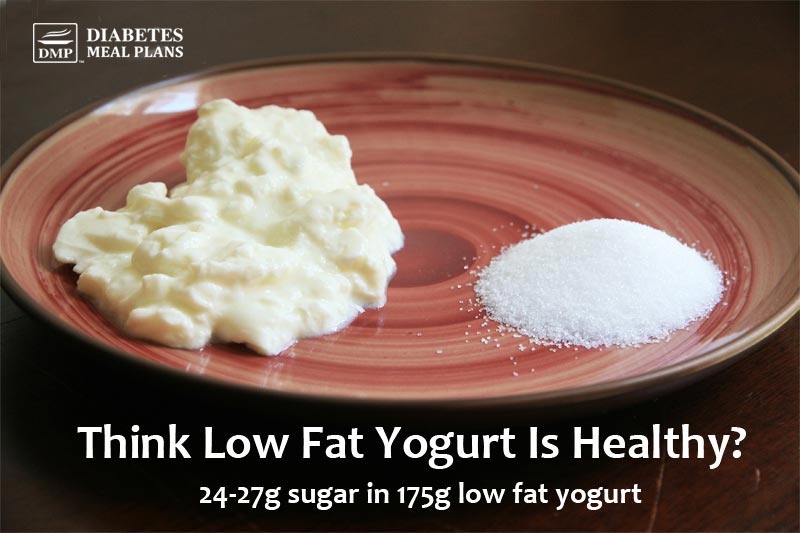
A plain low fat yogurt can have 24-27 g sugar per serve. Full fat Greek yogurt has far less carbohydrates/ sugar than a low fat option, coming in at around 6 g per serve.
Most low fat dairy products will be higher in carbs and sugars compared to full fat dairy options.
As a diabetic, one of the most important things for lowering blood sugar and A1c levels is monitoring carbohydrate intake, so don’t exclude monitoring (some) dairy from this list (see more on this below).
The Research on Diabetes And Dairy
In recent years we have seen new science emerge showing that full fat products are not an issue, and may actually be protective for diabetic health.
Eat Full-Fat to Reduce Risk of Prediabetes and Type 2 Diabetes
According to research, people have lower risk of getting prediabetes or type 2 diabetes by eating full-fat dairy.
Reduced risk of prediabetes by 25-39%, particularly in people who regularly eat yogurt and milk.
Reduced risk of type 2 diabetes by 63-70% for those who ate high-fat dairy and cheese with 4 or more serves per week.
Another study in adults found those who ate full-fat dairy had lower prevalence of prediabetes or type 2 diabetes, while those who ate low fat dairy had higher prevalence.
In another study, high-fat dairy was found to protect against prediabetes, whereas low-fat dairy was neutral.
In Prediabetes, Full-Fat Dairy Reduces Risk of Type 2 Diabetes
As Time magazine clearly puts it:
“A recent review published in the European Journal of Nutrition of the existing research on dairy fat came to some surprising conclusions: People who eat full-fat dairy are no more likely to develop cardiovascular disease and type 2 diabetes than people who stick to low-fat dairy.”
According to other research, full fat dairy is better than low fat.
“Those who ate the most high-fat dairy products had a 23 percent lower risk of developing type 2 diabetes than those who ate the least,” Dr Ulrika Ericson, from Lund University, Sweden said.
Ericson’s study looked at almost 27,000 people to see what dietary fat food sources might lead to increased rates of type 2 diabetes. What they found was that those consuming more high-fat dairy products, particularly cream, yogurt and cheese, had a decreased risk of diabetes, while low-fat dairy showed an increased risk.




Full-Fat Dairy Improves Prediabetes Health
Full-fat dairy, especially yogurt, was found to lower fasting blood glucose and insulin concentrations, and also improved cholesterol – lowering triglycerides and improving the total cholesterol to HDL ratio.
Full-Fat Dairy Has Little Impact on Type 2 Diabetes
Randomized controlled trials (1, 2) in people with metabolic syndrome or type 2 diabetes have generally found it makes no significant difference whether people eat full-fat over low-fat dairy when it comes to blood sugar levels, HbA1c levels or body weight.
In terms of insulin resistance, one study found it made no difference to insulin sensitivity whether people ate full fat or low fat dairy – the result was the same.
Dairy Products Nutrition List
Here’s the list of dairy products from lowest to highest in carbs.
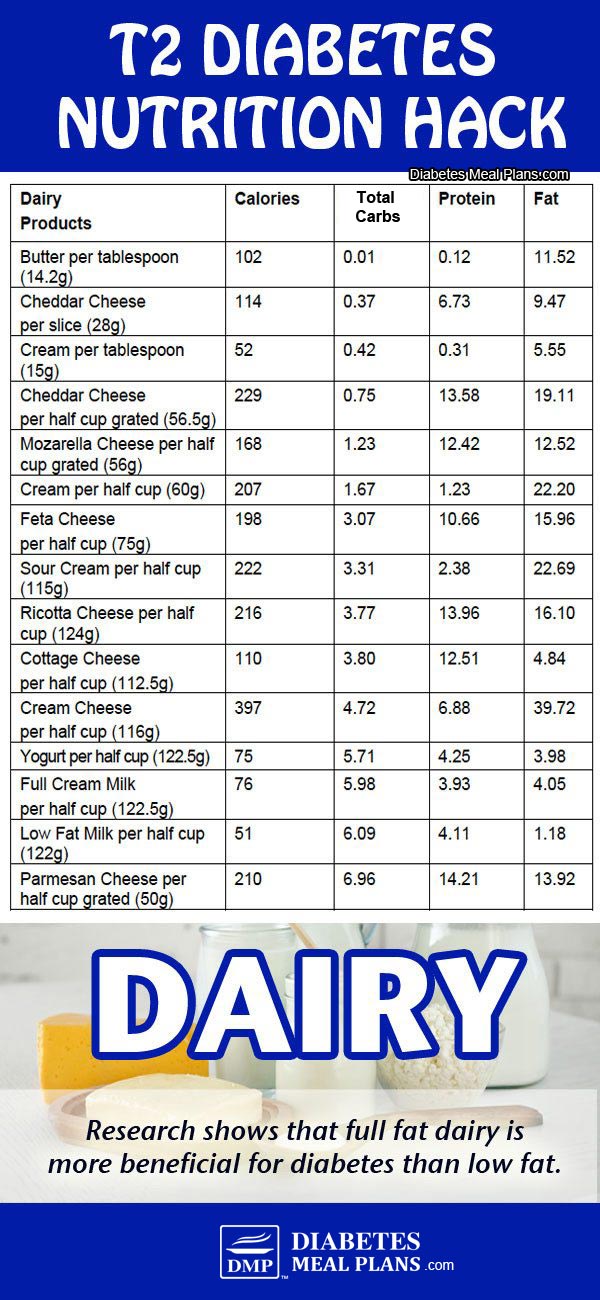
Why are some dairy products high in carbs and others aren’t? It all has to do with the lactose content.
Lactose is a form of sugar/ carbs. Products like milk and yogurt have a higher level of lactose, whereas something like cheddar cheese has none. The more lactose in a dairy food, the higher the carb count will be.
What Are The Best Dairy Products To Eat?
As you can see from that nutrition list above, your best choices are going to be:
BEST – lowest carb
- Cheddar cheese
- Mozarella cheese
- Cream
- Butter
Next best – can still eat regularly
- Feta cheese
- Ricotta cheese
- Cottage cheese
- Sour cream
Higher in carbs – but still healthy in a diabetic diet
- Yogurt
- Milk
- Parmesan cheese
In fact, no dairy product is off limits, as dairy products are whole foods that are nutrient dense and that’s the types of foods you need to reverse diabetes.
Does That Mean Low-Fat Dairy Should Be Avoided?
No, not exactly.
If you prefer low fat dairy, then go ahead and eat it. But keep in mind that low fat often means higher in carbs and sugars, so always check labels.
Plus, healthwise, there is no evidence to suggest low fat dairy is any better than full fat dairy.
Conclusion
So if you’ve been worried about eating dairy, don’t be. Dairy products are a natural whole food with lots of nutritional benefits!
Despite the growing amount of research, many diabetes organizations are still recommending low fat, high sugar products. So if you’ve worried about eating full fat dairy products, the evidence shows there is nothing to worry about there either.
The fact is that all of the new research we have around dairy proves it is a nutrient dense whole food with valuable health benefits, which makes sense of course!
There are lots of perpetuating nutrition myths in our society, so it’s great when they can be challenged with science that shows us the truth!

Mary Hennicke
What about Glucerna? My physician suggested it for protein and carb balance. I’m a long time type 2 diabetic.
John Franey
Sounds like most all cheese are ok, curious about Monterey pepper Jack cheese were it fits in the best to next best categories, thanks much
Dr Jedha
Hi John, yes, all cheese tends to be ok. Monterey Jack cheese per half cup is 215 calories, 1.8g carbs, 16g fat, 12.5g protein, so it is in the lower carb range for cheeses, after mozzarella.
John Franey
Thank you Dr. Jedha that’s good news as I’m kinda addicted to pepper Jack cheese 😎
Dotti White
So I have been having trouble getting started because of the breakfast choices. Can’t eat eggs every day…maybe twice a week. I really wanted to be able to use fruit and greek yogurt or cottage cheese. This will be a great stabilizer to get started! I am going to look for more variations with these ingredients. I do have a question, though. When I have a breakfast such as this, are there certain “types” of lunches and dinners I should look for to include to make up for the higher carb count earlier in the day?
Jedha: Nutritionist (MNutr)
If you eat cottage cheese and berries, your carb count isn’t going to be that high. Nor is having a little yogurt. There are also plenty of other breakfast options – nut muesli’s, low carb porridge, low carb breads with any topping of your choice. We have tons of recipes inside our VIP Membership site.
Jan
The mixed berry parfait for breakfast seems to be too high in fat (almost 2/3 of total calories is made up of fat and 13 grams of sugar). Isn’t that a bit high for a diabetic?
Jedha
Ignore sugar Jan, it’s irrelevant. There is zero “added” sugar in this meal. And carbs is the only thing you need to count, not sugar. This meal is higher in carbs with berries and yogurt but for a breakfast 25 grams is acceptable. As for fat, that’s irrelevant too. It’s a long story, so look out on the blog next week for more info about fat and cholesterol. And take a look at these guidelines on eating a lower carb diet – as you can see, fat ratios go up. Fat is the nutrient that has the least effect on blood sugar and A1C – and our body does need it.
Lori
I have been making my own whole milk Greek yogurt in the instant pot pressure cooker I usually use 1/3 cup per serving. Do you think that is Okay once in a while? It is hard to figure out the calories and carbs because I make it and strain it myself. I also save the whey for use in cooking.
Jan Oneill
Wellll once again what has been pounded into us over the years is now wrong. I am totally confused. Might as well relax and just eat what you want in moderation.
Jedha
It can feel like that sometimes Jan, but the fact is, there is a lot of new research that is turning what we thought we knew on it’s head. Sticking our head in the sand doesn’t help so keep learning, ask questions and find what works best for you.
Slade
Now this is very useful info. Seems like I might have to switch from Feta (My Favorite) to cheddar. Thanks for sharing this.
Phyllis
Right now I over the place with food but do try my best. But you guy is give the help thanks
Jedha
You’re welcome Plyllis, glad you find it helpful. Just take it one step at a time with small changes and keep moving forward. :)
Jennifer
I had been eating dairy like you recommend but then my doctor wanted to see my cholesterol numbers lower since I am now diabetic. My numbers for the bad started at 127 and over 9 months had brought down to 117 with diet and I tried looking at lower fat options but you’re right that they end up being higher in sugar or having a list of ingredients I can’t pronounce. I am sticking with the natural and watching can content. One thing I have found useful in these lessons is to count for the fiber which reduces the net carb count.
Jedha
It’s always best to listen to your doctor but remember you can also discuss aspects of your dietary choices with them too. Great to hear your diet is working for you though. Glad you’re enjoying the lessons :)
Marie
I was confused about yogurt but I’m very confused about what fruit to eat in the morning…..
Do frozen blueberries and strawberries raise our sugar? If so what fruit is the best?
I’m learning so much from your e-mails, especially your sample meal plans……THANK YOU.
Jedha
Glad you’re enjoying it Marie :)
Blueberries and strawberries are a good choice. Here is some info on fruit https://diabetesmealplans.com/677/best-fruit-for-diabetes-type-2/
Giselle
Quick question, is Greek yogurt lower in carbs than normal yogurt? Thanks Giselle
Jedha
Whole plain yogurt has a similar carb count to Greek plain yogurt. They all vary a bit so just check the labels and avoid the flavored, added sugar types.
Giselle
I found this useful, thanks, I was eating more feta than Cheddar thinking it was better. Whoops Giselle
Jedha
It happens Giselle :)
Missie
What about Swiss cheese? That’s my favorite, I was diagnosed with type 2 diabetes a few days ago and I feel lost. My bg is all over the place between 250 and even went up to 400 after drinking an ensure shake. Won’t be doing that again!
Emily - Dietitian (MS, RD)
Swiss cheese is perfectly acceptable, really all cheese is a ‘yes.’ If you’re feeling lost consider checking out this food list for really simplified information.
As far as the Ensure goes, I would definitely stay away from those. Very high in sugar and also highly processed. (This even applies to most meal replacement drinks marketed towards diabetics!) If you’re looking for a protein drink consider making your own protein shake. Look for a protein powder without any artificial sweetener in it and as few ingredients as possible. This article will give some further suggestions for picking a protein drink.
Brewster
My daily breakfast usually consists of a bowl of unsweetened cereal. Shredded Wheat or Muffets cold, or hot Buckwheat, Quaker Oats or Oat Bran. I sweeten them with a dash of Stevia and have been using skim milk forever. Saturday is toast day, for me two slices of thin marble bread with light Becel and light peanut butter, also have Fifty 50 sugar free jam. The Becel I’m using has 87% less fat than butter.
Sunday is egg day, two poached eggs on the a toasted slice of the marble bread accompanied by small pieces of ham or peameal bacon
A cup of perked coffee is a daily starter with skim milk and Stevia.
I’m a heart/stroke patient so it’s important to watch my fat intake.
Stephanie
Hi — I’m learning a LOT from your emails, but this one….. the list of cheeses is not useful to me at ALL, because of the different amounts. How do I compare “worst to best” if the serving sizes are all different?
Jedha
ALL of the items except the first 3 are for half cup of each item, so it’s actually easy to compare. The only reason the first 3 are also included in smaller servings is because people tend to eat smaller portions of them, so it is useful to have the smaller portion nutrition details as well.