


Table of Contents[Hide][Show]
Why is oatmeal raising my blood sugar, I thought it was meant to be a healthy food for diabetes?
Is oatmeal actually a healthy food for people with diabetes or is it all just hype?
Do the “whole grains” and dietary fiber in oatmeal make up for the high carb load?
These are common questions, and for good reason; there is a ton of conflicting information out there about oatmeal! Let’s clear up the confusion.
LISTEN TO THE PODCAST
Support the podcast by leaving a 5-star rating and review on Apple, Spotify or our Website – Thank You!
The Oatmeal “Health Halo”
Oatmeal is one of those foods that seem to have a “health halo” around it.
A lot of health providers give their patients generalized snippets of diet advice—“eat oatmeal” is a popular one.
Many talk about it as if it will magically cause us to be healthier once we start eating a bowl every day. But for individuals with type 2 diabetes, this advice can be disastrous, as eating oatmeal can cause blood sugar to rise.
Why?
To put it simply, oatmeal is a high carbohydrate food.
Quick answer: With type 2 diabetes, carbohydrates are the nutrient that affect blood sugar levels the most. Oatmeal is a high carb food and is not suitable for many people with diabetes.
Carbohydrates in Oatmeal
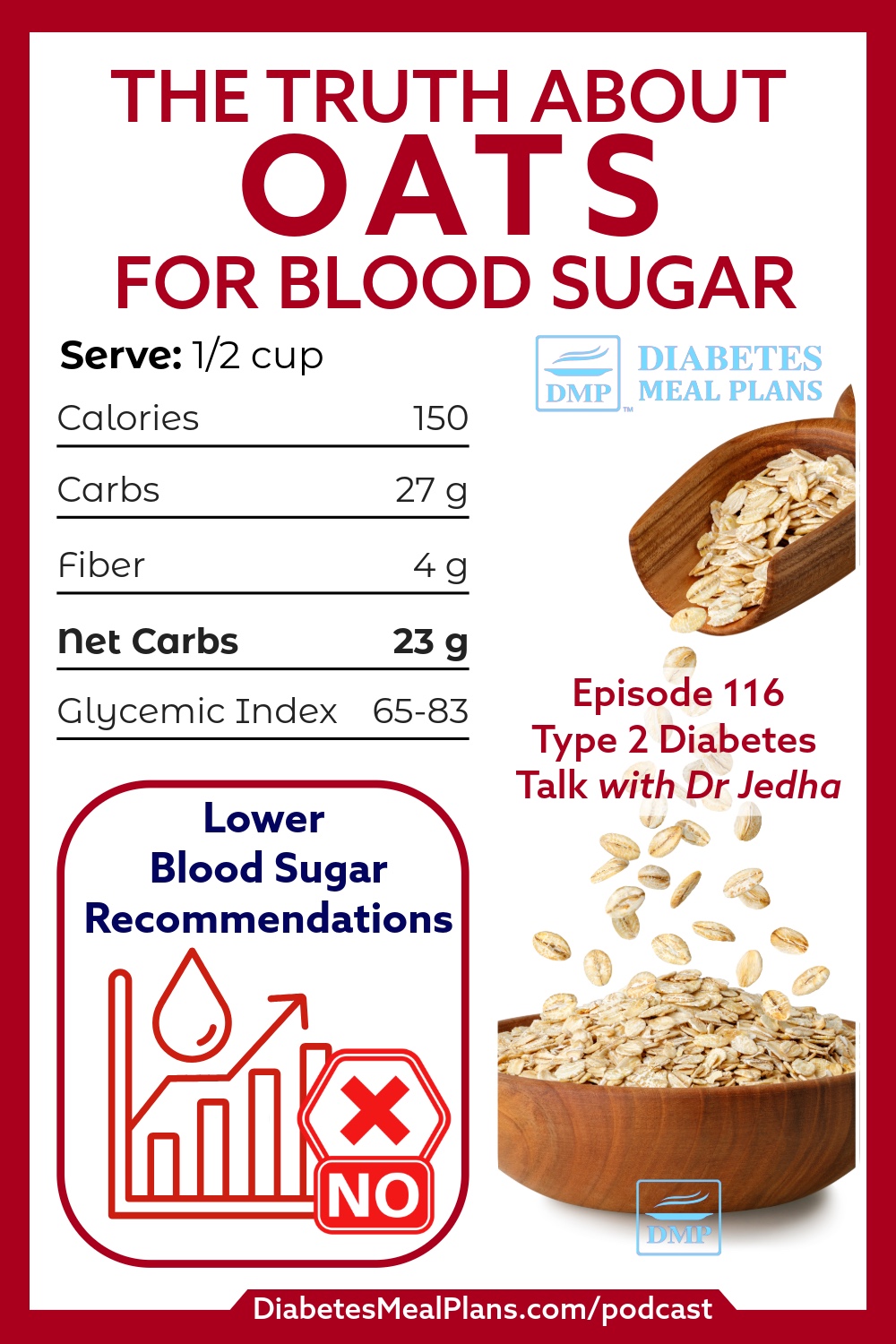
There are about 23 grams of net carbs in 1 cup of cooked oatmeal. And while the amount of fiber (4g) in oats is better than a lot of other breakfast cereals, is it worth consuming when the likely result is higher blood sugar levels?
First off, there are PLENTY of low carb foods with tons of fiber (think non-starchy veggies!) so you can easily get enough fiber by relying on veg and low carb fruit alone.
Next, let’s consider what the research says.
The research on oats and diabetes is mixed; for some people with diabetes, oats can be tolerated in small amounts. But, if you’re eating oats and your blood sugar is spiking, it may not be a good choice for you.
Our experience is that most people do best without it.




Test Oatmeal Before it Hits the Trash
But.. before you toss that box of oats into the garbage can, you can try these tips to see if your blood sugar responds any better.
First, make sure you are not adding additional carbs to your oatmeal such as milk, honey, sugar, or dried fruit.
For extra flavor, try adding low carb additions like chia seeds or chopped walnuts instead. If you need some sweetness, you can add some stevia.
Next, keep the portion size in check. Ideally, you want to only consume about a quarter-cup serving cooked.
Lastly, the type of oats can make a difference so make sure you are choosing whole oats over instant. A packet of instant oatmeal has a much higher glycemic index compared to the same amount of steel-cut oats. This may impact your blood sugar response.
Continue to check your blood sugars after consuming oatmeal to see your response and if the above adjustments make any difference.
If blood sugar is rising (especially over 140/ 7.8), this is not a good food for you and you’re better off eating a lower-carb breakfast.
Reinvent Breakfast
Maybe it’s time to challenge your preconceived notions of what a healthy breakfast should look like.
We all remember those cereal commercials when we were growing up showing a huge bowl of cereal, orange juice, milk, and two slices of toast as a balanced breakfast—that couldn’t be further from the truth, especially for people with prediabetes or type 2 diabetes!
A balanced breakfast should contain protein, healthy fat, and fiber.
Try to choose low carb, high fiber sources such as nuts, seeds, non-starchy veggies, and even small amounts of low carb fruits such as berries.
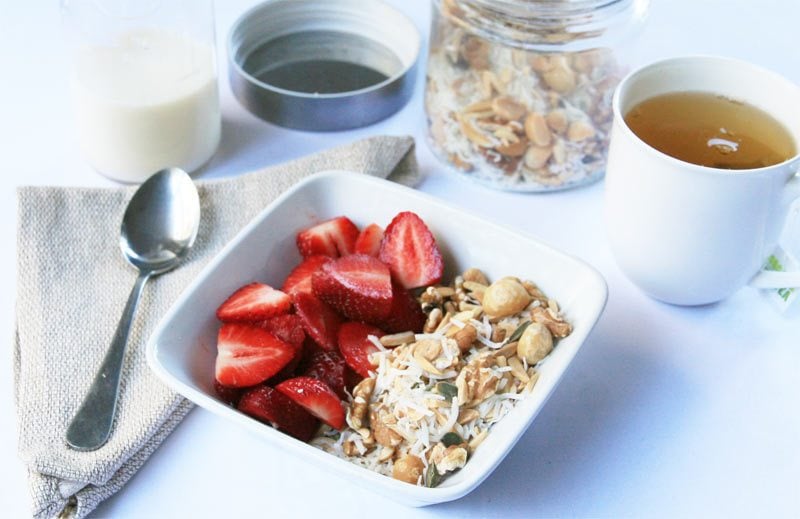
A few examples of balanced breakfast include:
See how your blood sugar responds to these lower-carb breakfast options, and compare that to a bowl of oatmeal when you test your blood sugar levels – you may be surprised by the difference.
Transcript
Hello wonderful people, thanks for joining me.
Today I want to dive into a food that causes more confusion than almost any other breakfast item: oats and oatmeal. It’s one of those foods that gets held up as “heart-healthy,” “wholesome,” “good carbs,” all the buzzwords. And if you’re living with prediabetes or type 2 diabetes, you’ve probably heard at least ten different pieces of advice about it, many of them contradicting each other.
And honestly, I hear the same kinds of questions every single week.
People ask me, “Do you know if eating oatmeal is good for diabetics?”
Or, “I make steel-cut oats and add honey and fruit, is that enough to balance it out?”
Others tell me, “My dietitian told me eating porridge is healthy and to include it in my meals, so what’s the deal?” And then there’s the classic: “I’m confused. Can I eat oatmeal or not?”
This episode is all about clearing up common confusions about oats and oatmeal. We’re going to look at the nutrition facts, the glycemic index, what the research really says, and most importantly, how oatmeal behaves in real people with real blood sugar patterns. Because that’s what actually matters.
By the end, you’ll know exactly whether oatmeal fits your body, or whether it’s one of those foods that looks healthy on paper, but sends your glucose numbers on a rollercoaster.
Alright, so let’s start with the simple question everyone wants answered: Is oatmeal good for diabetics?
The short answer — oatmeal can work for a small number of people. There are always exceptions, and some individuals genuinely do handle it well. Their blood sugar stays steady and oats don’t cause any problems for them. But for most people with prediabetes or type 2 diabetes, oatmeal is a high-carbohydrate food that sends blood sugar straight up. And that’s the part most people don’t hear. Oats are often promoted as “healthy,” but healthy for who? Healthy in what context? A food can be nutritious and still be completely unhelpful for your glucose control.
The real question to ask yourself is: What does my blood sugar do when I eat it? Not what the box says. Not what you’ve been told at a clinic. Not the health claims on the front label. What does your meter say?
If your blood sugar is creeping up, if you’re struggling to lower your A1c, or if mornings are the hardest part of your day, oatmeal is usually part of that pattern for many people, and not a good part. As you’ll discover today, oats and oatmeal just have too much carbohydrate in one hit for most people who are trying to stabilize their numbers or reverse their condition.
So before we even get into the nutrition facts or the glycemic index, that’s the key message:
Oatmeal isn’t automatically “bad,” but it’s rarely the best choice for someone trying to manage glucose levels.
Now, let’s talk about the biggest reason oatmeal causes so much trouble: the carbohydrate load. And this is where things start to make sense for people, because once you see the numbers, the blood sugar spikes aren’t a mystery anymore.
When you look at the nutrition facts, oats are simply a carbohydrate-dense food. Even a small serving packs in a lot more carbs than people realize. For example, depending on the type of oats you use, you’re looking at anywhere from about 19 grams of carbs on the low end, all the way up to more than 50 grams for some quick or instant versions. And remember, that’s before adding anything on top.
Most people aren’t eating plain oats cooked in water. They’re adding fruit, honey, raisins, maple syrup, all of which add more sugar. So a bowl that starts with 25 or 30 grams of carbs can quickly turn into a 40- or 50-gram+ meal without you even realizing it.
And here’s the thing: out of all the macronutrients — protein, fat, and carbs — carbohydrates have the biggest and fastest impact on blood sugar. Protein doesn’t spike blood sugar too much. Fat doesn’t spike it. Carbs do. So starting your day with a heavy carbohydrate load, doesn’t give you a strong foundation for the day.
Overall, the carb count of oats and oatmeal is simply too high for most people trying to manage prediabetes or type 2 diabetes.
If you take ½ cup of cooked steel-cut oats, 18.6 grams of carbs, 1 teaspoon of honey around 6 g carbs, 1/2 apple or banana, 10-12 grams carbs – even there we’ve got around 35 grams of carbs, and not that much fiber, maybe 3-5 g, which unfortunately, means blood glucose spikes for most people.
So once you understand that, the whole oatmeal puzzle becomes a lot clearer: it’s not that oatmeal is evil — it’s just that your body reacts to carbohydrates in a very particular way, and oats supply them in a concentrated form.
Now, one of the biggest reasons oatmeal is promoted so heavily is because of its fiber content. If you’ve ever Googled “healthy breakfast,” oats are always sitting right at the top of the list, mostly because of this idea that they’re a “high-fiber food.”
And look, fiber is fantastic. We absolutely need it. It helps digestion, supports the gut microbiome, keeps us feeling full, stabilizes blood sugar, lowers cholesterol, it does a lot of good things. Most people aren’t getting enough fiber, so I completely understand why oatmeal has earned this health halo.
But there’s an important detail that often gets missed.
The main type of fiber in oats is a soluble fiber called beta-glucan, and yes, there’s research showing beta-glucan can improve cholesterol and even help with glucose control. But—and this is the part no one really talks about—you only get those benefits when you consume around 3 grams of beta-glucan per day.
To reach that amount, you’d need to eat roughly ¾ cup of dried oats. And that serving size gives you about 40 grams of carbohydrate in one hit. Most people with prediabetes or type 2 diabetes can’t eat that amount without seeing a significant blood sugar spike. So while the beta-glucan story is scientifically valid, the dose required makes it unrealistic for most people who are genuinely trying to improve their A1c.
And here’s the other key point: You don’t have to rely on oats for fiber.
There are plenty of blood sugar-friendly foods that give you just as much, or more, fiber without the glucose surge.
A few examples:
- One Tablespoon of chia seeds has 8 grams of fiber.
- Half an avocado gives you around 6.7 grams of fiber.
- One cup of broccoli gives you about 5 grams.
- An ounce/ 28g of hazelnuts contains 4 g fiber
- Even a medium carrot gives you nearly 2 grams.
So yes, oats contain fiber, but they’re not the only source. And they’re definitely not the best choice if you’re trying to increase fiber without increasing your blood sugar.
This is where people often tell me, “Ah, now it makes sense.”
Let’s move into another piece of the oatmeal puzzle that people often lean on: the glycemic index, or GI. You’ll hear phrases like “steel-cut oats are low GI,” or “instant oats are high GI,” as if that alone determines whether oats are good or bad for blood sugar.
The glycemic index is simply a measure of how quickly a food raises your blood glucose on a scale of 0 to 100. Lower numbers mean a slower rise; higher numbers mean a faster rise. It’s useful in some situations, but it doesn’t tell the whole story, especially when it comes to diabetes.
Here’s how oats stack up:
- Oat bran: GI around 51
- Whole grain oats cooked with water: 51
- Steel-cut oats: 55
- Oatmeal porridge: 64
- Instant oats: 76
- Instant packets can go as high as 83
So you can see there’s a pretty big range depending on the type. Whole oats and steel-cut oats sit in that low-to-medium GI category, while instant oats head straight into the high GI zone.
But here’s the important part, and it’s the part that gets overlooked in almost every discussion: The glycemic index doesn’t cancel out the carbohydrate content.
You can have a low-GI food that still contains a large amount of carbs. And oats fall right into that category. Even the lowest-GI versions still contain 25, 30, even 40 grams of carbohydrate per serving. And for most people with prediabetes or type 2 diabetes, that’s enough to raise blood sugar regardless of how slow or fast it digests.
This is why some people say, “But I chose steel-cut oats, shouldn’t that be better?” It’s better on paper, but not necessarily better in terms of your blood sugar results.
A low-GI, high-carb food is still a high-carb food.
So while the GI of oats offers some information, it doesn’t solve the underlying issue. The carbohydrate load is still the biggest driver of blood sugar spikes.
Now let’s talk about the research, because this is where things often get misunderstood. Many dietitians recommend oats to people with diabetes based on the idea that they’re “heart healthy” or “high fiber” or “good for cholesterol,” but when you look closely at the evidence specifically relating to blood sugar and A1c, the story isn’t nearly as strong as people think.
One of the biggest points to understand is this: Most of the studies showing benefits from oats don’t use regular oatmeal. They use concentrated forms of oats, like beta-glucan extracts, oat-enriched drinks, or formulas specifically designed to deliver a higher amount of beta-glucan without all the carbohydrate.
In other words, researchers aren’t asking people to eat a big bowl of oatmeal for breakfast and then measuring their A1c. They’re using controlled, concentrated supplements, and that’s a very different scenario from what you’d eat at home.
The research consistently shows that to get meaningful benefits, especially for cholesterol, you need about 3 grams of beta-glucan per day. We talked about this earlier. To hit that amount through actual oats, you’d have to eat around ¾ cup of dried oats, which gives you about 40 grams of carbohydrate in a single serve. And that’s simply too much for most people trying to stabilize blood sugar.
So yes, there are benefits associated with beta-glucan. But the practical reality is that the amount required is incompatible with good glucose control for most people living with prediabetes or type 2 diabetes. And when you step back and look at the broader evidence, the research does not show that eating oats or oatmeal is an effective strategy for lowering blood sugar or A1c. That’s the key point. The benefits you hear about are largely tied to enriched products, not everyday oatmeal.
This is why so many people say, “I thought this was supposed to help me… but my blood sugar says otherwise.” The common advice on oats and oatmeal just isn’t based on outcomes that apply to real-life for people trying to manage blood glucose.
Now that we’ve unpacked the carbs, the fiber, the GI, and the research, let’s bring this into everyday life. Because people aren’t just asking, “Are oats good or bad?” They’re asking, “Okay… but what should I do?”
So here are some simple do’s and don’ts that help cut through the noise.
DO: Choose whole oats if you’re going to test it
If you’re determined to see whether oatmeal works for you, stick with whole or steel-cut oats. The research is clear that these forms digest more slowly than instant or quick oats. Just keep in mind, “slower” digestion doesn’t mean “no blood sugar rise.”
DON’T: Add fruit or honey
I know it feels like you’re building a nutritious bowl with apples, berries, raisins, honey, or maple syrup… but all of these are extra sources of sugar. If oats already come in high on the carb count, adding more sugar on top is almost guaranteed to spike your blood glucose.
DO: Use nuts, seeds, or vanilla instead
If you want to stretch out the carbs a bit, stick with additions that offer healthy fats and fiber, such as chia seeds, walnuts, pumpkin seeds, or even a splash of vanilla extract. They won’t magically cancel out the carbs, but they won’t make things worse either.
DON’T: Go overboard on portions
It’s incredibly easy to over-serve oats because they look small when dry. But once you start eating more than half a cup cooked — or even a quarter cup for many people — that carb load stacks up quickly. For most people, even that smaller serving can still be too much. Perhaps one or two tablespoons in a homemade muesli or overnight oats could work if you want to test.
Which brings us to…
DO: Test your blood sugar
At the end of the day, your meter is the most honest feedback you’ll ever get. If you want to know whether oats work for you, test before eating, then again 1 to 2 hours after. If you see a spike, you have your answer. No guesswork, no “maybe it’s good, maybe it’s not.” You will know if oats work for you.
DON’T: Rely on oats for fiber
You have plenty of better ways to get fiber, vegetables, avocado, nuts, seeds, and low-sugar fruits. You don’t need oatmeal to meet your daily fiber needs.
And let’s just recap the BIG PICTURE
Some people can tolerate oats. Most people don’t. And that’s okay, it doesn’t make the food “bad” and it doesn’t make you the problem. It simply means your body responds differently.
In the end, the goal is always the same: stable blood sugar, a lower A1c, and meals that actually work for your physiology.
So, where does all of this leave us?
Oatmeal is one of those foods that sounds healthy, looks healthy, and is marketed as healthy, but when you look at what actually happens in real blood sugar readings, it’s just not a great fit for most people trying to manage or reverse prediabetes or type 2 diabetes. The carb load is high, the glycemic impact is real, and the amount you’d need to eat to get the fiber benefits is simply more than most people can handle without a spike.
Oats are simply not the best choice if your goal is stable blood sugar and a lower A1c.
If you’re unsure, test it. Your blood sugar will give you the truth every time. And if you’re ready for a more reliable breakfast option, choose meals built around protein, vegetables, and healthy fats, the foods that genuinely support steady glucose throughout the day. We’ve covered breakfast ideas in episodes 19 & 68.
Thanks for joining me today and I’ll see you in the next episode.
Dr Jedha, over and out.

Mrs. Smith
Borrowed from Medical News Today
“Low glycemic index (GI)
Whole oats are slower to digest and have lower GI scores than quicker forms of oats.
Steel-cut oats have a GI score of about 53, and rolled oats — of about 57.
Steel-cut oats may take longer to digest, reducing spikes in blood sugar. Both oat types are better choices than other forms, such as instant oats, which have a GI of about 83.”
I am currently interested in the inner workings of the glycemic index. Why are there so many contradictions when it comes to carbohydrates and how they affect the body? My husband was recently diagnosed with Type 2 Diabetes and searching for the right recipes have been nothing short of frustrating and confusing. Any help would be appreciated.
Mrs. Smith
Emily - Dietitian (MS, RD)
The premise of glycemic index is that foods with higher fiber don’t spike one’s blood sugar as much, and therefore are lower on the glycemic index scale. I would recommend that your husband focuses more on total carbs, rather than glycemic index. You can read more about glycemic index and its limitations in this article here.
Christine
I see all of these articles about type 2 diabetes. What about people who are type 1.
Emily - Dietitian (MS, RD)
The research and information we provide is focused on Type 2 Diabetes. Much of the information and recommendations are transferrable to someone with Type 1 Diabetes, however not all of it is. Lowering processed food and/or carb intake can be beneficial for Type 1, but much more caution needs to occur with any dietary changes if someone is taking insulin. Your doctor may be able to help guide you to a resource more directed to someone living with Type 1 Diabetes.
Carole
Very informative. Diabetes consumes my life. I have a average A1C of 6.4, with type 2 diabetes.
I need more easy quick diabetic recipes. Thanks for your articles.
Etebom Nseyo
Really, I loved (still do) eating Oatmeals. But recently I observed increase urinating and abnormal sugar hikes. Same with Breadfruits.
And I start wondering: So what should a high sugar patient be eating?
Jedha: Nutritionist (MNutr)
We don’t recommend oats because most people do get blood sugar hikes. Refer to our recommended food list for help with foods to eat.
Etebom Nseyo
Thank you so immensely! I appreciate
Teresa Cokes
Thank you for explaining so well. I realize I have to make changes.