


Imagine going for a routine blood test, expecting everything to be fine, only to discover your A1c is 10% and told you’ve been diagnosed type 2 diabetes.
That’s exactly what happened to Michael. His diagnosis came as a complete shock.
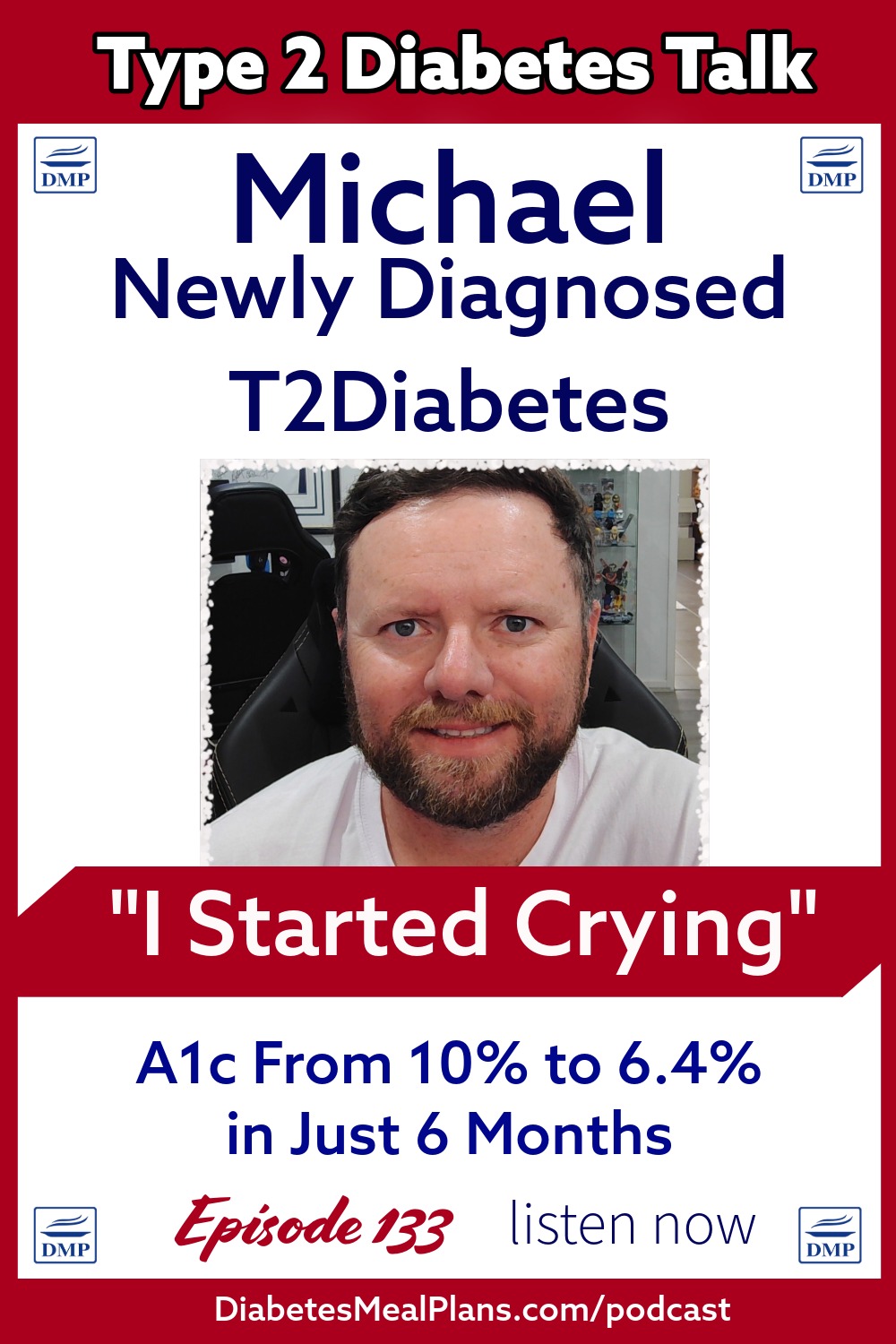
Just six months later, Michael had lowered his A1c from 10% to 6.4%, lost nearly 15 kg (33 lb), and made significant improvements to his overall health.
And when his doctor delivered those results, Michael was so overwhelmed with emotion that he started crying.
In this episode of Type 2 Diabetes Talk, Michael joins Dr. Jedha to share his remarkable journey, from the shock of diagnosis to discovering how changes in food, movement, and everyday habits could transform his health.
PODCAST VIDEO
PODCAST AUDIO
Support the podcast by leaving a 5-star rating and review on Apple, Spotify or our Website – Thank You!
What You’ll Discover in This Episode
- The shock of diagnosis: How Michael discovered his A1c was 10%, despite having no major concerns flagged at his previous annual checkup.
- The everyday habits that needed to change: How convenience foods, takeout meals, and a sedentary work routine had become part of his daily life.
- Why education made such a difference: How Michael discovered the Type 2 Diabetes Talk podcast and began learning how to improve his blood sugar.
- The power of small, consistent changes: How he transformed his eating habits and went from struggling to reach 5,000 steps a day to regularly aiming for 20,000.
- A family-wide transformation: How healthier eating became something his wife and children embraced together.
- The emotional moment his results came back: Why Michael cried when his doctor told him how much his A1c had improved.
- The importance of ongoing support: How the T2Diet Program, recipes, education, and member check-ins helped him stay focused and motivated.




More Than Just Better Blood Sugar
One of the most inspiring aspects of Michael’s story is that his transformation has gone far beyond his A1c.
He’s developed a completely different relationship with food and exercise, involved his family in healthier habits, and discovered a renewed sense of responsibility for his long-term health.
As Michael explains, his goal is simple: to be around for as long as possible for his children and, hopefully, future grandchildren.
His experience is a powerful reminder that a type 2 diabetes diagnosis doesn’t have to define your future.
Watch or listen to Michael’s interview above to hear his story in his own words.
Ready to Start Your Own Journey?
Michael’s journey began with education and a willingness to make changes.
If you’re ready to improve your blood sugar, lower your A1c, and take charge of your health, our research-backed T2Diet Program can help you get started.
You’ll have access to step-by-step nutrition education, practical food guidance, meal plans, recipes, and ongoing support to help you put what you learn into practice.
Get started for as little as $20/month – it will change your life!

Transcript
Click Here To View
GUEST, Michael: 00:00
I kind of have regular blood tests with my GP kind of every twelve months or so. He just said, Oh, your A one C is like ten percent and I’m like, Holy crap, that’s not good and he goes, You’ve got type two diabetes and I just sort of almost started to break down in disbelief. Went kind of s six months later. And in that result, I was down to six point four. As soon as he told me I started crying, and my wife was like, What is that good? What’s what’s wrong? I thought six six was good. And I was just so overwhelmed that like I’d made that turnaround.
Intro-Outro: 00:39
Welcome to Type 2 Diabetes Talk.
HOST, Dr Jedha: 00:43
Hello, wonderful people. Thanks for joining me for another inspiring episode of the podcast where we’re going to be sitting down with Michael. Michael shares his experience of being newly diagnosed with a very high A1C of 10%, and how he’s significantly lowered that over the past six months, lost weight, improved his mental health, among other things, and how the impact of his changes are rippling throughout his entire life. This is a great, inspiring podcast, so let’s get started and sit down and chat with Michael right away.
GUEST, Michael: 01:22
Hi, how’s it going?
HOST, Dr Jedha: 01:23
Yeah, good. How are you, Michael?
GUEST, Michael: 01:25
I’m really good.
HOST, Dr Jedha: 01:27
Thanks so much for meeting with me today. It’s so great when members volunteer to do it. I know it’s a it can be a bit nerve-wracking for some people to come on and share their experience, but I also think it’s such an important component of the community too, because it really does help to encourage other people. So I’m really grateful that you agreed to come on and share.
GUEST, Michael: 01:51
That’s okay. Um as if I can motivate one extra person to do something to make the step forward, then it’s worth it, even if I’m uncomfortable or it’s not what what I’m super comfortable doing. That’s pe I want to help someone some other people as well. So I need them to take that step and go on the pathway forward that I did.
HOST, Dr Jedha: 02:12
Yeah, and so I guess that’s a good place to start. Maybe Michael is well, you were newly diagnosed with type 2 diabetes, right? So maybe you can share a bit about how your journey began.
GUEST, Michael: 02:23
I kind of have regular blood tests with my GP kind of every 12 months or so. Beforehand, I knew I hadn’t been doing the best things for my health and the best eating and all that kind of stuff. But the last one there hadn’t really been anything flagged outside of cholesterol issues, which I’d kind of thought that I was probably working on a little bit, but I’d had medication as well, so I was on that and I was less like just continuing my life and in my routine of not doing the best kind of things. Um and then yeah, before we did it, my wife was like, Maybe you should like clean up your act a bit. And I’m like, Well, I would have had to do that a couple of months ago to to really like see any any difference. And I just went there thinking nothing would would come of it. And then he just said, Oh, your A1C is like 10%, and I’m like, Holy crap, that’s not good. And he goes, You’ve got type 2 diabetes, and I just sort of almost started to break down like in disbelief that like the one before hadn’t really flagged hadn’t flagged anything, and then this one had. But yeah, when I looked back at what I’d been doing for probably the last six months, I was like, Well, yeah, I probably haven’t been looking after myself and I’ve been taking a lot of easy options and fast options, just not doing the right things. So yeah, instead of preparing my own meals and things like that in the morning, I’d take kids to school and I’d get something on the way home, a bakery or a cafe or McDonald’s or Hungry Jacks or something like that. And that was my routine. I’d do that through the week, like multiple times a week. So so when I looked back, I was like, Yeah, I’m not making very good choices. And I was getting up to 100 kilos in weight, and I was just sort of ballooning around there and not doing a lot of exercise. And because my job is primarily working from home, I sit in front of a screen most of the day, not making the effort to get up and move around very much either. When I kind of looked around that, I was probably doing 5,000 steps a day would be a good day for me. Yeah, it really did. Open my eyes. And me being me, I the doctor wrote the prescription and I was like, my wife knew what was gonna happen. I was just gonna go get it filled and then probably continue what I was doing. But yeah, she was the one that said, You’re not getting the medication. So we’re gonna make a change. She basically we came home that day and she said, Go eat whatever you want today. This is like your last hurrah, and then from today, you gotta clean up your act, look at what you can have for breakfast, we’ll look at better food choices, we’ll prepare more stuff at home, and then yeah, we just started the journey from there.
HOST, Dr Jedha: 04:58
So basically your new look new your new diagnosis did come as a real shock. Just as an interesting question, do you think in that year preceding, because you said it was normal the year before, and then do you think you really went right off track that last year, or do you think it was slowly building anyway?
GUEST, Michael: 05:16
Yeah, I think it was bad health habits and it was probably slowly building. I also do have a family history because my grandmother had type two byte diabetes, my mom does as well. So it’s in the family, so maybe it was just kind of laying there in the background, and yeah, probably that last 12 months, when I look back at like what I was doing to myself in terms of choices, it was kind of sad in a way. Or yeah, if I look at my past self, I’m just like, how how did I just do that? Yeah, it was a sort of shock to my wife as well, because I just basically came out and said, This is what I’ve been doing. And she was disappointed that that’s the choices that I’d been making. But she’d gone back to work, so I was just like at home by myself. Um previous to that, I was kind of on the rails because she was home, and then pretty much from wet from then I’ve gone off the rails and you know, she used to prep my lunches and things like that. So I I went from that to just having to look after myself, and I just didn’t make the right choices looking after myself.
HOST, Dr Jedha: 06:14
It’s quite easy to do rail and just it’s not something you were focusing on yourself really before with your wife helping out. So interesting.
GUEST, Michael: 06:22
Yeah, like well it went from like she would do the school drop-offs and all that kind of stuff and the meal prep for dinner and all so I wouldn’t have to do anything, and then it went from that to me doing school drop-offs and helping them with their lunches, and I wouldn’t make my own lunch then, I’d just make theirs. Um, and then when it came to I’d be like, what am I gonna have for lunch? And I’d just make a decision and that’s what I’d have. If there was something here that I wanted, it might not have been the best choice to make for lunch either.
HOST, Dr Jedha: 06:47
Yeah, how interesting. So then your wife was encouraging you, obviously. You found out you diagnosed, your wife was encouraging you to make some changes, which is great. And helping you to do that. And so where did your journey go from there? I remember you might have found the podcast at some point, or were you looking around? What what kind of happened there?
GUEST, Michael: 07:06
Yeah, so I obviously I decided, well, I have to get moving, right? That’s number one. So I was like, all right, I’m gonna start going for a walk in the morning, cutting out processed food, cutting out like takeaway food. I had to do that, and you know that that’s not great for you. And then I was like, okay, I need to get some education, and I like listening to sports podcasts and things like that about sports that I like. So I was like, there has to be a diabetes podcast. So I was like googling around, and then I was like looking at a few of them, and then I saw your one and I’m like, looked at your background and on what you’ve been doing on your research. So I was like, well, this looks like the most informative one that I can start off with, and yeah, I fired that up and was off on my walks in the morning, and that started my journey about learning things, and then I was like, I would come back and say to my wife, hey, I I heard this on the podcast and I heard that, and the the podcast is was, you know, the first part of motivation, and then I was like trying to get through them like super fast because every time I listened to one, I would learn something new. So it was really good. It was helping me like and motivating me that I was making the right steps.
HOST, Dr Jedha: 08:09
Yeah, that’s really good. And then you were lucky enough to be a recipient of Curtis’s generosity, because we know Curtis also started with an A1C of ten percent and he lowered his down to five point six percent. He’s in the normal range and off his diabetes medications now, which is awesome. And he gifted a few memberships to people, and it’s been great to see that you took advantage of that opportunity as well to really apply yourself to doing the same, I guess.
GUEST, Michael: 08:41
So I’ve taken that opportunity, I’ve really run with it and I’ve changed my life. And it’s you know, not not in a small part due to him. Um because that really did motivate me as well, that really did make me buy in because I I was taking advantage of something that Curtis had provided me. So I kind of felt indebted as well to make sure that I followed it through and that through the twelve months that he gifted me of membership, that I had to take that and I had to hold true to getting a result from it, because otherwise I would have just wasted you know, my maybe wasted my time, but wasted his investment.
HOST, Dr Jedha: 09:21
Yeah, when you came in, did you you put yourself into the program and focused on the guidelines even more? How was that journey for you?
GUEST, Michael: 09:29
I was going through the podcast and I was trying to catch up, and I I think I got to the one about Curtis and his like generosity right when it was ending. I was pretty much thinking, I’ll try and get it and then see what it’s about, and then you know, if I’m lucky enough to get it, then that’s great. But I was still thinking I’m gonna sign up anyway, because I need something to help me to give me more information because the podcasts are fantastic, but that’s not where all the information is, right? In in the members portal, there’s so much more information in there. So yeah, I went every time the program would come out every week, I’d go through all the information, I’d watch the videos, and then I was like just basically trawling through all the knowledge base kind of articles and looking at all the recipes and looking at ideas and then trying to encompass some some of those into what we were doing and speaking to my wife about maybe we can substitute a couple of things for me or for everyone, and that yeah, so that was a really good help for us to try and think outside of the box and just go outside of our standard rotation of meals. To the fact now that we just have so many different recipes that we have. Every week we just go through a massive list and we just with the kids’ help, they help us decide what we’re gonna eat for the week. Everybody kind of picks something and then we’re kind of encouraging the kids now to to cook with us and things like that, so that they know how to cook properly as well, and and they get some enjoyment out of cooking the meal and everybody enjoying the meal together.
HOST, Dr Jedha: 10:54
Oh, I love that. That’s so wonderful that it’s translated over to the whole family now and everybody’s benefiting from that.
GUEST, Michael: 11:02
Yeah, no, and they love they love picking a recipe and then cooking it, and then at the end everybody like tastes it and really likes it. There’s been a couple of that haven’t gone so good, and people are like, Yeah, let’s not make that one again. Um, but for the most part it’s really good. It like just gets them some more responsibility as well and teaches them better habits than just throwing chicken nuggets in an air, because that a lot of time that’s what they would want to do.
HOST, Dr Jedha: 11:28
So Yeah, absolutely, it does. It’s awesome. Then they’re learning about nutrition and better health over time, which is just gonna make such an impact on their lives, and it is already on your lives by the sound of it too. Just that shared time together is beautiful, like cooking meals together. It’s great.
GUEST, Michael: 11:46
Yeah, it’s a it’s a good part of the day. When I finish work for the day, it’s good to be out with the family and whoever’s meal it is, they they generally they’re the ones in charge and we help them with it, and then you know, the other people will be like hanging around looking for tasters or bits and pieces of ingredients that they want to eat along the way. So it’s it’s yeah, it’s kind of a good family time.
HOST, Dr Jedha: 12:06
Oh, I love that. That’s so great, Michael. And so I guess everyone would love to hear about what your results are now. So you said you started with an A1C of ten percent. So where so where are you at now? What happened after that?
GUEST, Michael: 12:21
Went kind of s six months later, and in that result I was down to six point four. As soon as he told me I started crying, and my wife was like, What is that good? Like, what’s what’s wrong? I thought six six was good. And I was just so overwhelmed that like I’d made that turnaround, and he was like looking at me weird as well, like, why why is he crying? When I’ve read this out, and then I was like, I just was so overwhelmed, I’d tried so hard, I’d lost close to 15 kilos, and it was just the relief that a result had happened at the end, like a positive result, that I hadn’t made all that effort for nothing. And then he turned around to me and said, Well, if you lose that much weight, there’s you’re definitely gonna have a positive result. I’ve never seen anyone not lose that kind of weight and stay the same or go backwards. So he he’s just basically said to me, Whatever you’ve been doing, just keep doing it, and it should keep trending down, hopefully. At that one too, he basically said, because I’d stopped taking my cholesterol medication in that period, and it was perfect. And I’d had some issues with my blood pressure becoming too low, like coming low on the medication that I was on. And I’d spoken to um my pharmacist about it, and he recommended they recommended to go on some half doses until I’d seen the doctor again. So I was doing half doses, and that was in that okay range, but on the lower side of okay, if you get what I mean. So I’m kind of trending towards maybe getting rid of that as well. So yeah, he’s he basically said at the next checking we’ll see how that’s going, and just to keep monitoring it, and then if it goes low again, then to come straight back, and then he’ll do an assessment and hopefully get me off that as well.
HOST, Dr Jedha: 14:01
Wow, what a turnaround. So from 10 to 6.3 at your last checkup and obviously trending downwards as far as we know, and weight down 15 kilo at that checkup, plus um a reduction or would you completely stop your cholesterol meds and reduce your blood pressure meds as well. That’s really an awesome outcome in you know, a short amount of time.
GUEST, Michael: 14:26
It kind of makes me feel bad for or bad about myself is that I let myself do that to myself, right? Is that like I’ve let life get away from me a bit. But it’s good that I’ve been able to take charge and turn it around, not rather than just say, oh well, that’s what it is, and then just start taking medication and just not even do anything about it. So so yeah, I think definitely my wife’s attitude, um, picking up the podcast and then learning as much as I could how to turn it around and how to do it without medication, that was the the key for me as well, finding alternatives and and and looking at things that I was doing or things that I could do better to really turn that result around.
HOST, Dr Jedha: 15:10
Yeah, and I think it’s normal to feel a bit of guilt toward previous behaviors or the way we might have treated ourselves, but it don’t hold on to that either, because the most important thing is that you’ve taken the proactive steps to change. And I think once you experience that as well, it’s difficult to turn back, especially when you’re seeing it the effect not only for your own health, but how it’s it’s you’re getting a ripple effect through the whole family as well.
GUEST, Michael: 15:37
Yeah, well, they’re supporting me to make sure that I’m here. My aim is to be around for as long as possible for my children and maybe grandchildren if they ever have decide to have children and that kind of thing. I can’t be here as long as possible if I don’t look after myself. So and and they want me to look after myself as well. So they’re all on top of me. Um and I’ve made so many changes around things that I just decided that I don’t need to have in my life anymore. So yeah, just some small things that I know I don’t want to go down a path of temptation as well. Is you know things are okay occasionally, but they can’t become a normal thing. So yeah, it’s really about keeping yourself in check as well and not beating yourself up too much, but yeah.
HOST, Dr Jedha: 16:21
Yeah, that’s exactly right. Keeping ourselves in check, just giving ourselves those reminders along the way is really important too, and I hope being a member is also helping with that as well, because you have that regular touch point with us as well, to the reminders and seeing other people in the community, etc.
GUEST, Michael: 16:40
So yeah, getting all the things about recipes and then yeah, the check-ins and all the the communications that are there and like just going on to look at recipes and things like that, that kind of keeps me engaged and in check, right? So I’m making sure that I stay focused and always thinking of how I’m improving myself and my health. My next obviously my next goal is to get off my blood pressure medication. I want to try and lose a bit more weight. I definitely weigh less than what I did when I got married, which is is kind of weird. I haven’t weighed the weight that I am for quite a long time, like over 20 years, I haven’t weighed this weight. So so yeah, it’s it’s quite quite good to be here and I don’t want to go back.
HOST, Dr Jedha: 17:23
Well that’s a great motivating factor, isn’t it?
GUEST, Michael: 17:26
Yeah.
HOST, Dr Jedha: 17:26
Yeah.
GUEST, Michael: 17:27
Yeah.
HOST, Dr Jedha: 17:28
So I always like to ask everyone what would be your best advice to other people who might be on the fence and they’re thinking, I really want to make a change in my life.
GUEST, Michael: 17:39
Well, I think you need to do it for yourself. And that’s the number one motivation. It needs to be for you. If you don’t do it for the right reason, you’ll probably fall off that track at some point. But it’s really you should always should make that first step forward, even just listening to the podcast. Getting as much information as you can. If you can do it, becoming a member is a really great resource. The amount of resources in there are ridiculous. There’s too many resources to read almost. Yeah, the check-ins are fantastic to just stay on track and hear other people’s stories, and there’s other people going through the exact same thing that you’re going through, and there’s people that have been in the situation that you’ve been in. It’s good to reach out to people, you know, need to reach out and get that help because sometimes you just can’t do it by yourself. You don’t have all the tools to do it, and and doing something like joining the program will give you the tools to be able to move forward and and give you a really good baseline. And from there you can just excel in yourself and make yourself the best version of yourself that you can.
HOST, Dr Jedha: 18:44
Yeah, that’s really good advice, Michael. And do you feel like Because you know, you were listening to podcasts but and you were gifted the membership, but do you feel like that’s made a really much bigger difference for you? Like, for example, if you’d just kind of gone along and listened to the podcast only or whatever else, but having just everything there in one place and just the focus, has that do you feel like that’s really helped a lot more?
GUEST, Michael: 19:11
I think it has because it’s given me a easy way to find information. I haven’t had to like trawl through the internet of a lot of disinformation, a lot there’s a lot of weird stuff on the internet. Like there’s some crazy things that you get taught that you can go down rabbit holes on the internet. So I think in the program that’s all the tools are there. Anything that I wanted to kind of know about, they were in there was articles in there, like you’ve done things on there inside the website. But it’s good to be able to have a a doctor on the end who is really invested in getting people healthy and giving people advice and not the easy way out of just handing medication to you, right? And empowering people to use these tools and the things that you’ve learned in your research to to make people’s lives better.
HOST, Dr Jedha: 20:03
Yeah, no, it’s uh one reason I love my my work is that it does make a big difference. It’s and it and when we hear the stories come from real people and all over the world we’re all located from Canada to UK to America to Australia to lots of different places, it’s just a wonderful impact to have and hear stories like yours, so I really appreciate you sharing.
GUEST, Michael: 20:30
That’s okay. I think yeah, your job would you’d get so much benefit from that hearing. Like there’d be so many people that you just yeah, they hear my kind of story from. Somebody who’s listening to me, one person makes a difference, it’s worth it, right? That that’s all all it takes as well. Is one person to take the motivation from what I did to do the same thing and and save their life, pretty much. In my opinion, this it’s kind of taken my life, control of my life back to me.
HOST, Dr Jedha: 21:01
But it is difficult sometimes to get that motivation to take the first step. Anything can trigger that in people though, I believe. So maybe your story does that for somebody. Maybe it’s something else, it just has to come from within, doesn’t it?
GUEST, Michael: 21:16
You do have to want to make the change. Like it’s you’re not just gonna magically wake up one day and it’s and you’re gonna feel motivated to go for that walk at 6 30 in the morning. Uh when I’m feeling like that, I’m just like, well, what are you gonna do? You’re gonna go back to bed and lay in bed all day and feel feel sorry for yourself, or are you gonna get outside and get some fresh air and some sunshine, hopefully, and you know, start your day really well with being outside in nature and you know, listening to your favorite podcast. Yeah, it’s just it’s just really good to to to make that step and then to change your life. It will become a lifestyle change. Once you start it, it’s it’s hard to stop doing it. And it’s and if you as long as you hold yourself accountable as well. It’s okay to not go out and exercise every so often, but it shouldn’t turn into a habit of not doing anything. It shouldn’t go from 20,000 steps a day to like sitting around doing nothing. And and I have gone from struggling to get to 5,000 to now my daily step target is pretty much 20,000 steps a day. So I I usually do seven to eight thousand before seven thirty in the morning and then through the day, and then my wife will come home and then we’ll go for a walk. And then if I feel like we’ve had a heavier dinner or something, then I might go out as well again afterwards. So it’s it’s it’s quite different because I would have never done that before. I would have never got up and gone, you know what, this dinner’s sitting heavy on me, I’m going for a walk. I would have just probably come into my office and got a packet of chips and eaten chips or something. So so yeah, it’s kind of a total mindset change. But it’s good to be in tune with your body as well, to know that stuff. Because you kind of do get in tune with yourself. So you know when you’ll know when you’ve eaten something you shouldn’t have eaten, or you’ve eaten too much and you’ve eaten the wrong thing or how it affects you. Like when you really clean yourself up and really think about things, you can really notice everything. I think it’s really good to empower yourself and like to think about yourself. And it’s not some people would say it’s bad to think about yourself like that, but you really need to be in tune with yourself and what you’re doing and how it affects you and your body and your mental health as well. I think really that’s a big thing too, mental health. So it’s definitely changed my mental health as well, which kind of makes me more accountable for myself, and which has been really good. Not not just in my health aspects too. It’s kind of changed the way that I think about social things, about work things. Um kind of makes me more accountable across all aspects of my life. Like, am I being the best version of Michael that I can be?
HOST, Dr Jedha: 24:07
That’s great. Oh, there’s so much gold in there today that you’ve shared. I just can’t wait to, you know, get the story, your story out there. And it’s just, I mean, again, like thanks for taking the opportunity that was given to you two from Curtis, because I’ve shared with him um the results you’re getting and a couple of the other members that were also gifted the membership. He was just ecstatic because he was the same. He’s like, wow, the fact that I’ve made a difference in someone else’s life was that that, you know, helped to change mine is just the most amazing gift he said to himself, that he just felt yeah, just wonderful about that. And I thought in the future sometime we should all get you guys together and on a Zoom as well, just to have a chat. It’d be awesome.
GUEST, Michael: 24:56
That’d be good. It’d be good to say thank you to him personally, because he’s changed my life.
HOST, Dr Jedha: 25:03
And how good is that that you’re all like Curtis can give back and you’re sharing your story, giving back, and you know.
GUEST, Michael: 25:10
As you said, I could have procrastinated and sat on it for like months, two months, three months, and eventually done it, right? But it w there was in my it was in my hand, right? I had no choice then to take advantage of it. I’ve got access to all these resources. I would have been a fool to just not really dive in and and take full advantage of it. And I think that’s what I did, right? I really dove in, took real advantage of it, took everything that I could read, everything that that I could hear, all the recipe ideas, all the things, little tidbits and things in there, and kind of melded them around and then produced the results that I produced. Yeah. Without all those resources, it would have never happened.
HOST, Dr Jedha: 25:54
Yeah, we went we need more stories just like yours and just like Curtis’s to pass on that that love and empowerment, I guess that’s called it. The the health, the health, pass on good health and empowerment.
GUEST, Michael: 26:06
Yeah, yeah. Good health is something that is just underrated, I think. Like just people just don’t rate it enough. It definitely needs to be pushed harder, and people need to see those benefits and really dig into how their health affects every aspect of their life.
HOST, Dr Jedha: 26:23
Firstly, I just want to say Michael seems like a completely different person to where he was not long ago. You can just get a sense of that through everything he shared, and he shared with us so openly, so thank you for that, Michael. But look at how far he’s come. He’s come from a complete lack of presence in his day-to-day habits through to a sense of empowerment, self-accountability, confidence in his choices, a completely different mindset and certainly a completely different lifestyle. And that ripple effect, wow. Now that is a huge impact because imagine that future impact on his kids. And not only that, but the uh things that have opened up for him in his life already, the quality time, the shared experience, uh all of that is so powerful. And uh I want you to keep the ripple effect in mind because uh when you do change your health, other people uh surrounding you will be influenced in some way, shape, or form. It does uh go on. I mean Curtis who we spoke to in episode 100 and uh gifted Michael the membership, his changes have affected other people. Some of the members he gifted memberships to, his family, his grandchildren, his children become affected. We talked to Carol in episode 107. She also shared how the changes she has made have influenced her family as well. Know that the things that you’re doing go far beyond you as well. Another important point. We can lose track of ourselves in life. It’s quite common. In Michael’s case, his wife went back to work and he just suddenly started bad habits without even thinking about it. In episode 132, we spoke to Charles, who’s a tennis coach, and he’s just putting other people first, not thinking about himself. And then maybe you get the wake-up call. In Charles and Michael’s case, it was that type 2 diabetes diagnosis. Or maybe you just turn around one day and you realize, hmm, these behaviors aren’t supporting my good health. Whatever the case, when that occurs, you can’t just stick your head in the sand and think that it’s going to fix itself. You have to step up and do something about it. As Einstein said, insanity is doing the same thing over and over again, expecting different results. We have to change something. And that was another good point that Michael made because he said, you have to want to make the change. So why do you want to make the change? Focus on that and just get started somewhere in your life. So one of the really good points Michael made, and something that we often emphasize in our members’ community and also on the podcast, is just to start from where you are. Start with the obvious things. And for Michael, that was getting rid of the junk food, getting rid of going to the takeaway shop or the bakery, and just starting to move more because he sits in front of a screen a lot of the day. So, what are the simple and obvious things you can start with? Think about that because oftentimes most of us have those things already present in our lives. As Michael shared, the podcast is a fantastic resource. And there are people who have completely changed their life using the podcast alone. Here’s a few of them who have left their reviews. So Robert said, DMP seems to incorporate the latest discoveries in their advice. Their info and handouts actually work. I work with an excellent medical group and I use the internet often to research and double check advice, but before DMP, my A1C kept creeping up. DMP does not use the term in moderation when classifying food and food groups that are bad for diabetics. I was able to use the food handouts from DMP to go from 9.6 to 6.1 in about four months. Amazing. Another one from Bill. I was diagnosed with type 2 diabetes over a year ago. I used the information from the show and after about 15 months I got my A1C down to 5.4. Amazing. I credit this show for getting me here, he says. Donna, pre-diabetic. This podcast helped me lose 25 pounds. That’s great that people in our extended community have made such great life changes. So please go and leave your review and share your story as well. The point is the podcast is a great source of information. And of course, we would love to welcome you as a member if you’re looking for more resources, tools, and ongoing support as well. So there’s a few important takeaways I want you to think about from this podcast. And that is to start paying attention. If you’re in a crappy place right now, that’s okay. But this is your life, so don’t let it pass you by. Make a choice that you want to change things and start focusing on how you can be the best version of yourself. Do it for yourself. There are so many things in life that may seem important, but your health truly is your wealth because without it you really have nothing. When you are healthy, you’re more valuable to your family, you’re more valuable to yourself, you’re more valuable at work. It has that ripple effect beyond you, and that is really powerful. And just get started. One meal, a short walk, something simple. And we may not always feel like doing those things, but it really is the simple everyday habits that make such an impact to the overall quality of our lives. You can make a change. No matter where you are right now, no matter how long you’ve had diabetes, you can make a change. So just get started and keep on going. I hope you feel truly inspired by today’s episode. Michael was very open with sharing his experience and his feelings and everything that he has gone through. And I just love it, as I’ve said before and will say again when our members step up and share their experience through the program and the results that they’re achieving because it shows you exactly what’s possible. You can make a change, you just have to decide that that’s what you want to do and get started. That’s all for me today, Dr. Jeddah Over and Out.
Intro-Outro: 33:49
Thanks for tuning in to Type 2 Diabetes Talk. For episode replays, episode notes, and more, visit type2diabetesalk.com
Subscribe to Type 2 Diabetes Talk on: Apple | Spotify | Amazon Music | Audible | YouTube | Podcast Index | Player FM | and more…
Leave a Reply